

Cost Assessment of Deep Borehole Disposal Options for TRIGA II Spent Fuel in Slovenia
Deep Isolation conducted a cost assessment to evaluate options for deep borehole disposal (DBD) of spent nuclear fuel (SNF) from Slovenia’s TRIGA II research reactor, considering both co-disposal with SNF inventory and development of a standalone repository. This study builds on an earlier feasibility and cost assessment completed by Deep Isolation in 2021 and reflects an enhanced cost methodology employed in a 2024 study for the Krško NPP inventory.
Challenges and Objectives
Slovenia must manage SNF from both its commercial nuclear power plant at Krško and the TRIGA II research reactor operated at the Jožef Stefan Institute in Ljubljana. While the TRIGA II inventory is small, 84 fuel elements that could potentially be packaged into a single Universal Canister System (UCS), it requires a disposal pathway that meets long-term safety and regulatory expectations consistent with international best practice for deep geological disposal.
ARAO engaged Deep Isolation on two occasions to evaluate the incremental cost and programmatic impacts of adding TRIGA II SNF to a Krško SNF repository and to compare this approach with development of a dedicated standalone repository under harmonized assumptions.
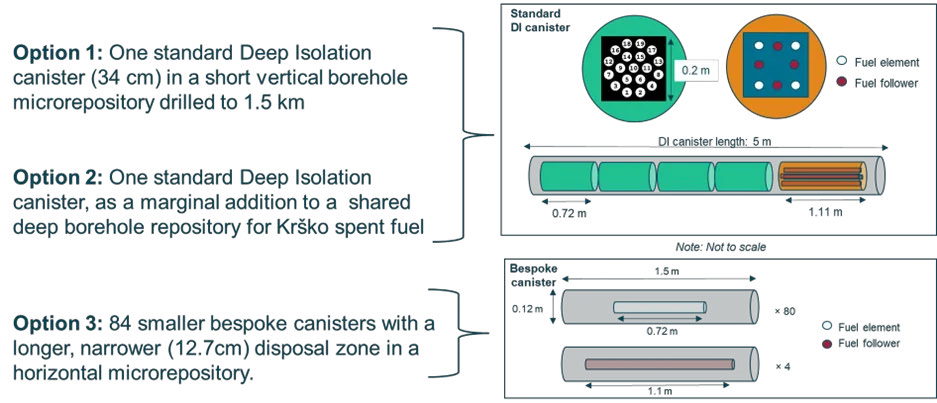
Packaging for the 3 Options (Not to Scale)
Methodology
Two primary scenarios were evaluated:
- Co-located disposal, in which TRIGA II SNF is added as a single UCS to a Krško NPP inventory horizontal deep borehole repository.
- Standalone disposal, involving a single vertical deep borehole repository developed solely for TRIGA II SNF at a generic off-site location.
Costs were estimated across the full repository lifecycle, including siting, licensing, construction, operation, closure, and post-closure institutional control. Sensitivity analysis was subsequently performed to assess the effects of contingencies.

Executive Brief
This study assessed the cost implications of disposing of Slovenia’s TRIGA II research reactor SNF using deep borehole disposal, comparing co-location with a Krško SNF DBD repository against development of a standalone facility. The study concludes that incorporating TRIGA II SNF into a Krško deep borehole repository results in a marginal cost increase, while a standalone repository incurs substantially higher costs due to fixed programmatic requirements.
- Co-locating TRIGA II SNF within a Krško repository increases lifecycle cost by less than ~0.5% of total repository cost.
- A standalone TRIGA II repository would cost approximately €65.6 million excluding contingencies and VAT, driven largely by fixed siting, licensing, and infrastructure costs.
- The results indicate that co-located disposal provides a materially more cost-effective solution while maintaining the safety and schedule assumptions of the Krško program.
About ARAO
The Agency for Radioactive Waste Management (ARAO) is Slovenia’s expert organization responsible for managing radioactive waste and SNF, carrying out state-authorized tasks in line with the highest international standards, and working to establish a comprehensive, safe, and sustainable system that permanently protects human health and the environment; drawing on domestic and international expertise, ARAO implements a technologically advanced, cost-effective management system based on minimizing waste generation, separating radioactive waste from other hazardous materials, applying multiple safety barriers, and upholding the “polluter pays” principle.
Results
The analysis shows a substantial cost difference between the two disposal strategies, driven primarily by fixed, facility-level costs that must be incurred regardless of inventory size. Co-locating TRIGA II fuel within the Krško repository avoids duplicating these costs, whereas a standalone repository would require a full, independent siting, licensing, and infrastructure program.
Adding TRIGA II SNF to a Krško repository increases total lifecycle cost by less than a ~0.5% increase relative to the Krško base case. This incremental cost is limited to a single UCS, associated encapsulation and transport activities, and approximately one additional day of emplacement operations.
By contrast, a standalone TRIGA II repository has an estimated lifecycle cost of €65.6 million excluding contingencies and VAT, increasing to approximately €98 million when contingencies and VAT are included. These costs are dominated by fixed siting, licensing, drilling, and institutional control requirements that do not scale down proportionally with the very small TRIGA II inventory.
Because the additional TRIGA II scope is minimal and schedule-independent, the incremental cost of co-located disposal is identical across all previously studied disposal scenarios at Krško with no adverse changes to safety, feasibility, or schedule assumptions.
Future Plans
This study provides a robust, methodologically consistent cost basis to inform Slovenia’s disposal planning for TRIGA II SNF. The results support integration of TRIGA II fuel into the Krško disposal program as the most cost-effective option and can be used to inform national decision-making, program sequencing, and stakeholder discussions. Any future work would focus on safety assessment, implementation planning, and regulatory engagement.

The study gave us a clear comparison of disposal pathways for TRIGA II spent nuclear fuel. It showed that integrating a small inventory into a repository for the Krško SNF can be done with minimal additional cost, without introducing significant safety or scheduling impacts.
— Sandi Viršek, CEO, ARAO
About Deep Isolation
Deep Isolation is the first company to undertake development of technologies for nuclear waste disposal in deep boreholes. When commercialized, Deep Isolation’s solution will offer a unique solution to help countries identify, plan for and complete the necessary steps to dispose of their nuclear waste inventories. With over 100 patents issued to date, Deep Isolation’s technology is being designed to leverage proven drilling practices to allow safe isolation of waste deep underground in horizontal, vertical, or slanted borehole repositories. Deep Isolation’s Universal Canister System was developed through a three-year project funded by the U.S. Department of Energy’s Advanced Research Projects Agency–Energy and is engineered to support integrated management of spent fuel and high-level radioactive waste from legacy and advanced reactors across storage, transportation, and eventual disposal. In January 2026, Deep Isolation launched a full-scale, at-depth deep borehole Commercialization Pilot for its solution at Cameron, Texas, in collaboration with the Deep Borehole Demonstration Center, Halliburton (NYSE: HAL), Amentum (NYSE: AMTM), NAC International, and Occlusion Nuclear Solutions.
For more information, visit: deepisolation.com