
Deep Borehole Repository Demonstration Program
Overview for Invited Stakeholders
Deep Isolation is undertaking a full-scale, nonradioactive demonstration of a deep borehole repository to validate the technology readiness, operational safety, and commercial viability of its disposal solution. The demonstration program is designed to provide regulators, policymakers, industry partners, and investors with direct, observable evidence that deep borehole disposal using the Universal Canister System (UCS) can be implemented safely and effectively using proven oil and gas drilling and nuclear waste package handling technologies. The program will culminate in a series of public and invite-only showcase events, beginning with today’s Groundbreaking Ceremony at the Deep Borehole Demonstration Center (DBDC) near Cameron, Texas.
Why a Demonstration Matters
Deep geological disposal is widely recognized as the most credible long-term solution for spent nuclear fuel (SNF) and high-level radioactive waste (HLW). While mined repositories have advanced in some countries, they typically require multi-generational timelines and significant capital investments (on the order of billions of dollars). Deep borehole disposal offers a complementary (or even alternative) pathway that leverages mature oil and gas drilling technologies to isolate these hazardous waste streams deep underground in stable geologic formations.
Extensive studies have shown that deep borehole disposal can meet stringent long-term safety requirements. However, feedback from regulators, waste management organizations, and policymakers has been clear: a full-scale, at-depth demonstration is the single most important next step to build confidence, validate models with empirical data, and establish a sound basis for regulatory review. Deep Isolation’s Deep Borehole Demonstration program is explicitly designed to meet that need.
The Universal Canister System
At the center of the demonstration is Deep Isolation’s Universal Canister System (UCS). The UCS is a standardized, multi-purpose waste package developed with support from the U.S. Department of Energy’s Advanced Research Projects Agency–Energy (ARPA-E) to support the safe storage, transportation, and permanent disposal of a wide range of nuclear waste forms.
The UCS has been engineered for compatibility with both conventional mined repositories and deep borehole repositories, reducing system complexity across the nuclear waste lifecycle.
Over the past several years, the UCS has progressed from concept through detailed design, prototype fabrication, laboratory testing, and safety and performance modeling. These activities established the technical foundation for the next phase: demonstrating UCS handling, emplacement, and retrieval in a deep borehole environment using full-scale equipment, procedures, and processes.
Demonstration Program Scope and Phasing
The demonstration is a self-funded, multi-year program executed at the Deep Borehole Demonstration Center in Cameron, Texas. Today, we are publicly launching Phase 1.
Phase I: Subsurface Demonstration (2025–2027)
Phase I focuses on proving the core subsurface elements of a deep borehole repository. Key activities include:
- Design and construction of a full-depth, horizontal borehole at a total vertical depth of over 4,000 feet in representative geology.
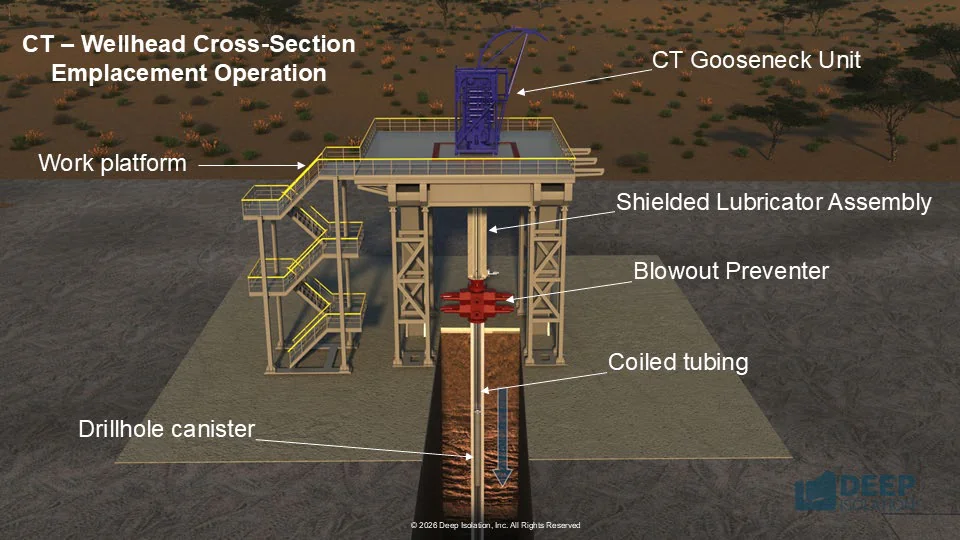
- Emplacement and retrieval testing of full-scale UCS canisters using standard oil and gas industry equipment.
- Validation of mechanical performance, operational procedures, and nuclear safety controls under realistic downhole conditions.
Phase I will culminate in an invite-only public demonstration event showcasing successful emplacement and retrieval operations at depth. Completion of this phase delivers the first full-scale, at-depth validation of physical emplacement and retrieval operations in a deep borehole – providing a critical proof point for the feasibility of deep borehole disposal and representing a genuine inflection point for the nuclear waste management industry.
Further Phases: End-to-End System Demonstration
Activities include:
- Fabrication and testing of repository surface handling equipment.
- Simulated surface operations, including canister staging, transfer, and interface with the borehole.
- A complete end-to-end demonstration moving a UCS canister from surface staging through emplacement into, and retrieval from, a deep borehole.
Our target is to conclude this work by 2028, with a full system showcase demonstrating readiness for commercial deployment and achieving TRL 7 – the highest technology readiness level achievable ahead of live deployment with radioactive waste. At this stage, the integrated system is considered ready to support formal licensing and detailed design activities and to build regulatory confidence prior to first-of-a-kind radioactive operations.
Safety, Testing, and Data Collection
Although the demonstration is nonradioactive, it will be conducted using nuclear-grade operational discipline. Procedures will incorporate conservative radiological safety controls, formal Go/No-Go decision points, and contingency planning for off-normal scenarios. Emplacement and retrieval operations will be repeatedly exercised to refine procedures and validate system robustness.
The program will generate high-value empirical data, including:
- Mechanical and operational performance of the UCS and borehole system.
- Thermal, pressure, and geomechanical measurements at depth.
- Observations relevant to long-term safety case development and model validation.
These data will directly support regulatory engagement and future licensing discussions.
Partnerships and Execution
The success of the demonstration program rests on the quality of the partnerships driving it. Execution is being led by Deep Isolation’s strong foundational Engineering team and carried out in close collaboration with a group of experienced industry partners, each bringing extensive leadership, domain expertise, and credibility to the program:
- Halliburton – borehole design and construction.
- Occlusion Nuclear Solutions – subsurface emplacement and retrieval operations.
- NAC International – lead for UCS & surface handling system design, procurement, fabrication, and execution of all surface handling operations.
- Deep Borehole Demonstration Center – site host and stakeholder engagement.
- Amentum – operational safety case development and quality assurance.
This collaboration ensures that the demonstration reflects real-world execution conditions and aligns with regulatory and industry expectations.
Public and Stakeholder Engagement
The demonstration program is designed around a series of visible milestones to maintain transparency and stakeholder confidence. Today’s Groundbreaking Ceremony marks the formal launch of on-site activities. Subsequent updates and technical showcases will highlight progress through drilling, construction, testing, and system integration.
By inviting regulators, policymakers, industry partners, and community representatives to observe key milestones firsthand, Deep Isolation aims to foster informed dialogue and build durable confidence in deep borehole disposal as a viable component of future nuclear waste management strategies.

Looking Ahead
Successful completion of this demonstration will represent a major step toward commercial implementation of deep borehole disposal. It will validate critical assumptions, reduce technical and regulatory risk, and demonstrate that disposal solutions can advance in parallel with the deployment of advanced nuclear technologies.
The Cameron, Texas demonstration is intended not as a one-off experiment, but as a foundation for broader adoption – supporting future customer projects, regulatory approvals, and international collaboration on safe, permanent nuclear waste disposal.