

Attitudes Toward Nuclear Waste in the United States
Public perspectives on permanent solutions for high-level radioactive waste
Prepared by Deep Isolation
Based on nationally representative public opinion research conducted by YouGov
AUGUST 2026
About this report
This report presents findings from nationally representative public opinion research conducted by YouGov in the United States in April 2026. The research was commissioned by Deep Isolation to better understand how Americans think about nuclear energy, radioactive waste management, and permanent disposal solutions for used nuclear fuel and high-level radioactive waste.
The study explored public attitudes toward nuclear energy, concerns about radioactive waste, support for permanent disposal, views on deep geological and deep borehole disposal, and how opinions changed after respondents received information about different disposal technologies.
The findings offer insight into a central question for the future of nuclear energy in the United States: how can the country move toward a permanent waste solution in a way that is technically sound, publicly credible, and responsive to public concerns?
Foreword

Nuclear energy is playing an increasingly important role in conversations about energy security, climate resilience, and industrial competitiveness. But any serious discussion about the future of nuclear power must also address a long-standing challenge: how to safely and permanently dispose of used nuclear fuel and high-level radioactive waste.
At Deep Isolation, we believe that solving this challenge requires more than engineering innovation. It requires public trust, transparency, and a willingness to listen. That is why we commissioned this research with YouGov: to better understand how Americans think about nuclear energy, nuclear waste, and the disposal options available today.
The findings are clear. Americans want action. They recognize the need for a permanent solution, and they do not want this responsibility left to future generations. At the same time, the research shows that many people are still unfamiliar with how nuclear waste is managed, and that concerns about safety, transportation, and long-term stewardship remain significant. The survey also shows strong trust in scientists and engineers to help guide decisions, reinforcing the importance of evidence-based policy and technically sound solutions.
As the United States considers the future of nuclear energy, it must also move forward on the waste question. The public understands this. The challenge now is to turn that recognition into progress.
Rod Baltzer
CEO & President, Deep Isolation Nuclear
1 Executive Summary
This report is based on nationally representative public opinion research conducted by YouGov in the United States from April 3 to April 8, 2026. The survey explored attitudes toward nuclear energy, radioactive waste management, permanent disposal, and how views changed after respondents received information about geological disposal options.
Support for nuclear energy is broadly strong, but radioactive waste remains a concern. 61% of respondents support the continued use of nuclear power in the United States, while similar shares agree that nuclear energy is important for U.S. energy security and can provide affordable, stable electricity prices. At the same time, concerns about nuclear accidents, radiation releases, and the lack of a permanent waste solution remain widespread.
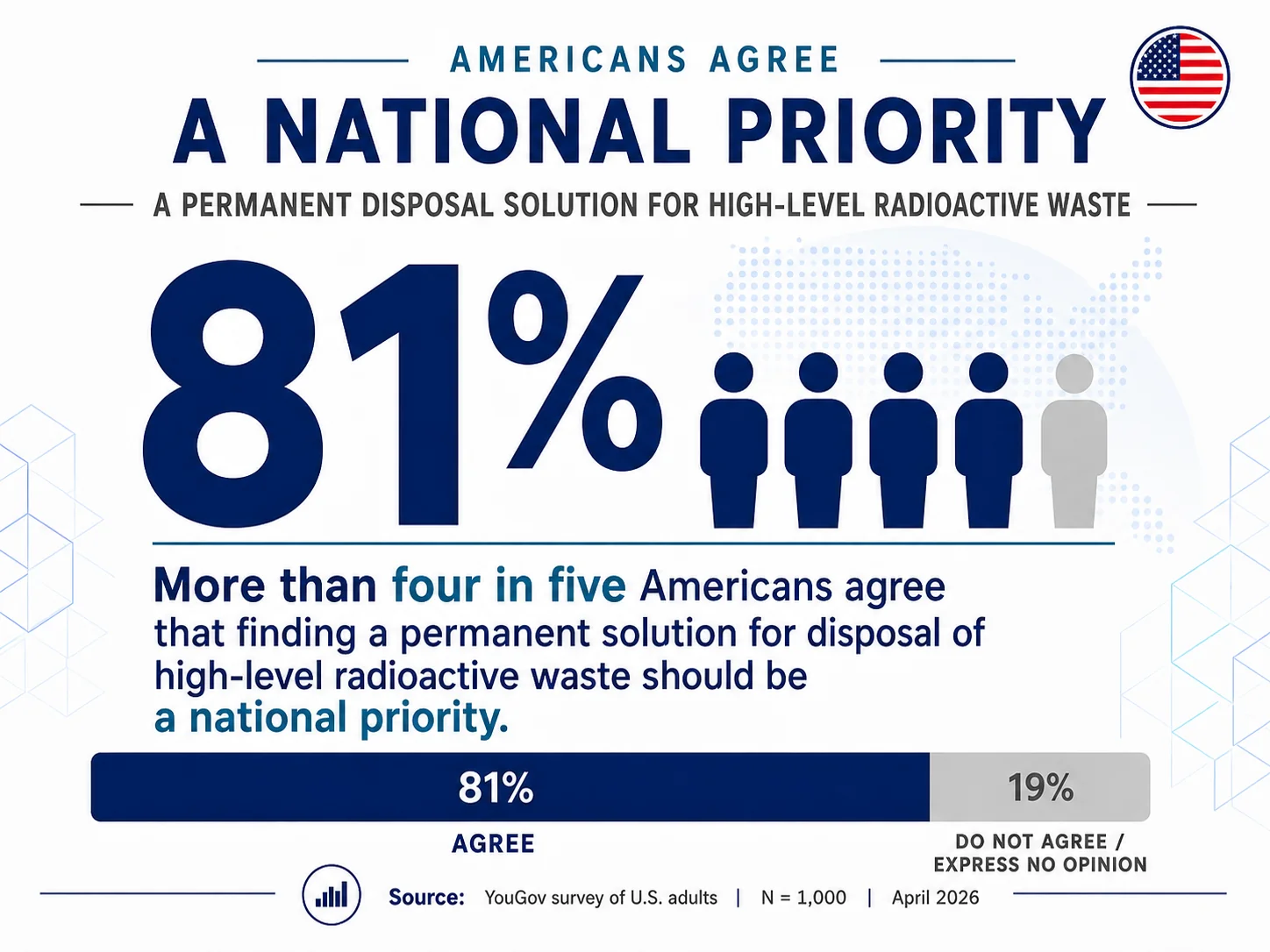
Americans favor action over delay. 81% of respondents agree that finding a permanent solution for high-level radioactive waste should be a national priority. By contrast, only 28% support continuing to store used nuclear fuel at reactor sites for many decades.
Deep geological disposal is viewed as a credible solution. A majority of respondents agree that placing high-level radioactive waste deep underground is a safe long-term solution. 74% also support underground disposal methods that reduce the need to transport used fuel and waste over long distances. Respondents also show support for allowing states to apply for licenses to develop geologic disposal facilities, subject to federal safety regulations.
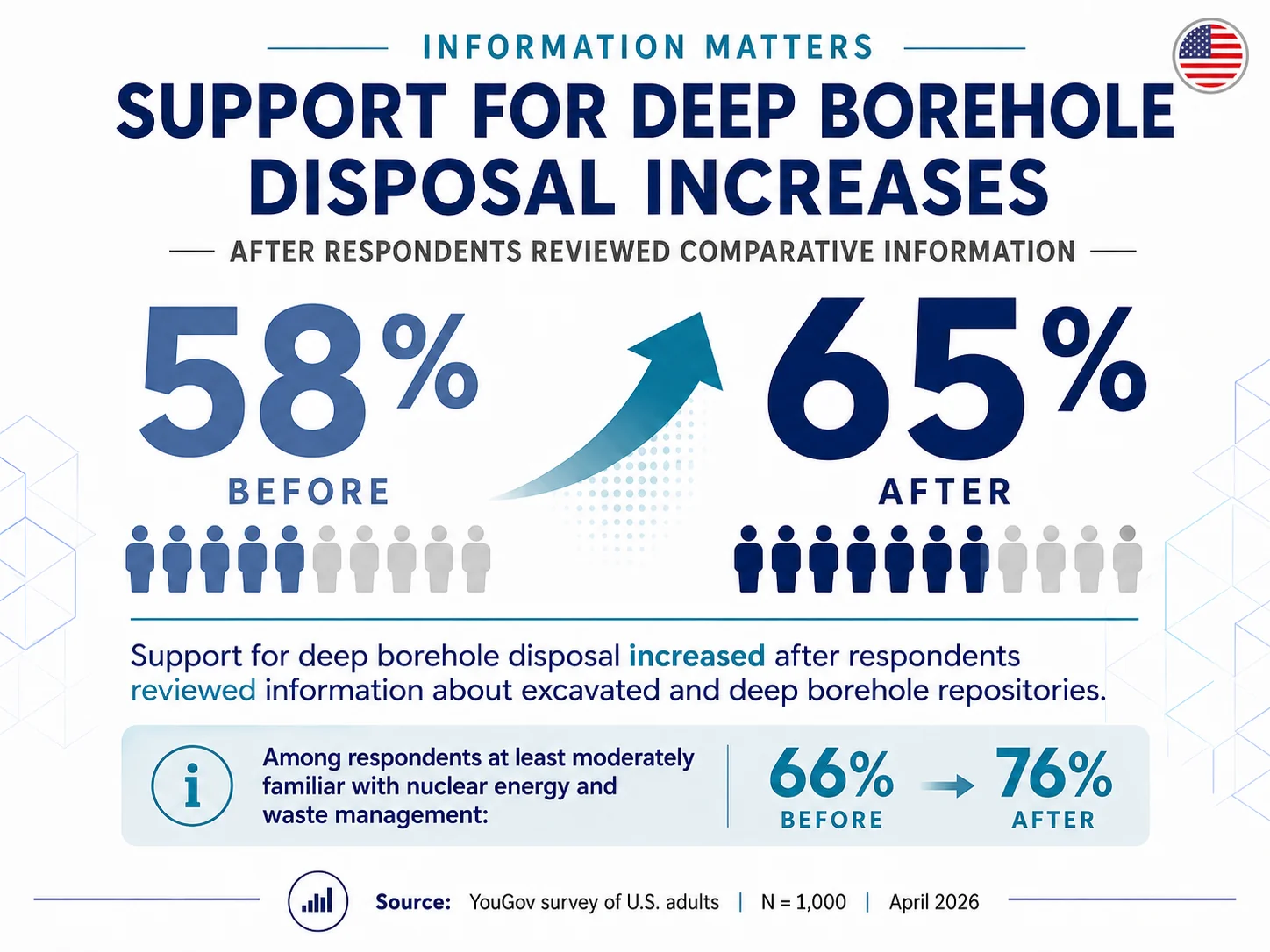
Information increases support for borehole disposal. After respondents reviewed information comparing excavated repositories and deep borehole repositories, support for deep borehole disposal increased to 65% after information, from 58% before information. Among respondents who were at least moderately familiar with nuclear energy and waste management, support increased to 76% after information, from 66% before information.
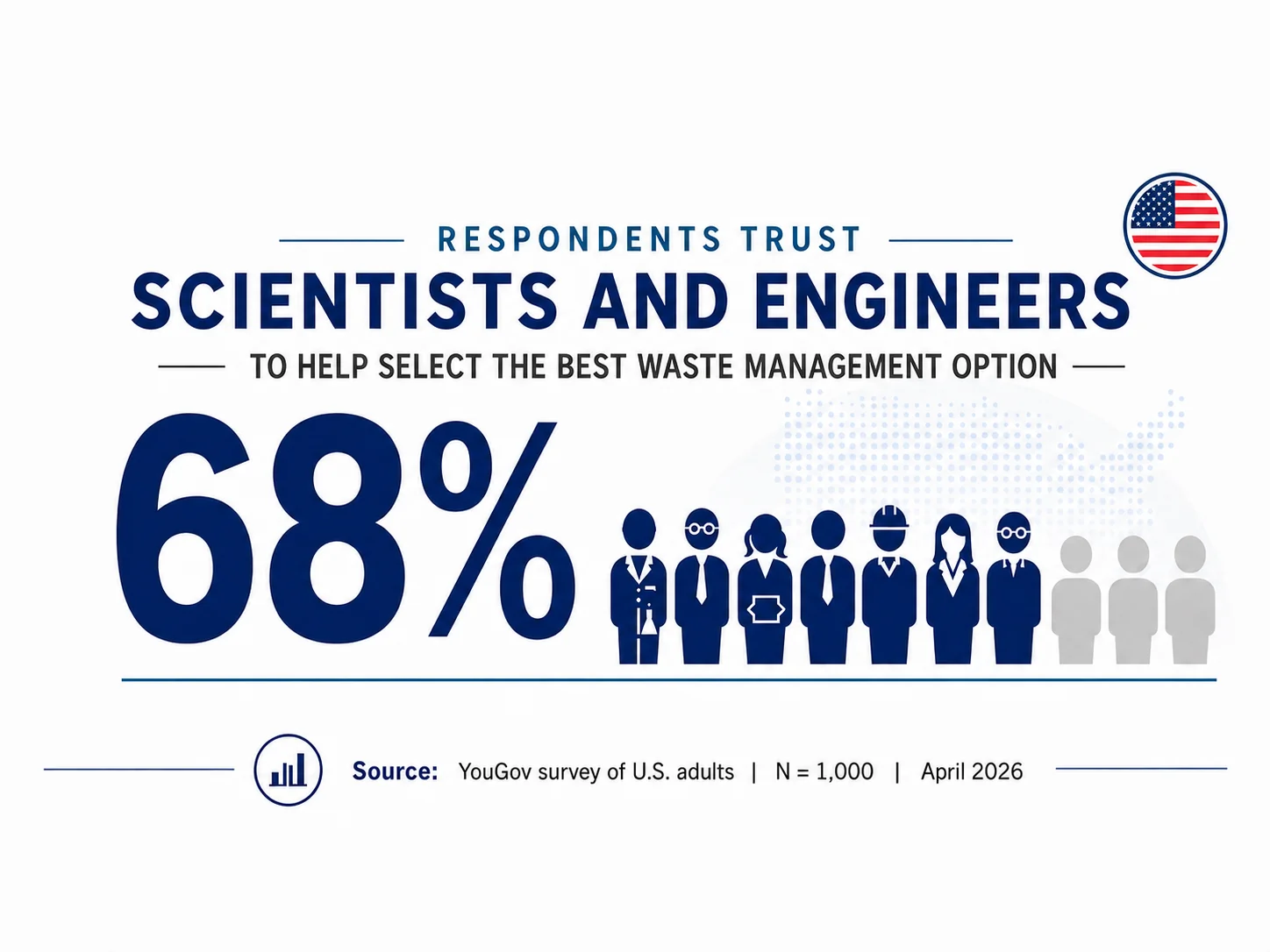
Americans place greater trust in scientists and engineers than in government alone. 68% of respondents trust scientists and engineers to assist the government in selecting the best waste management option. By contrast, only 37% trust the U.S. government to make sound decisions about nuclear energy policy. Together, these findings show that public confidence is stronger when technical experts are visibly involved in the process.
Support extends across regions and nuclear communities. The survey found no statistically significant regional differences in several core measures. Respondents living within 50 miles of a nuclear power plant were also receptive to deep borehole repositories after receiving information about the technology.
Taken together, the findings point to a practical path forward. Americans do not want the nuclear waste question postponed; they want a permanent solution that is safe, technically credible, and guided by trusted expertise. The results also suggest that public confidence will depend on clear communication, transparent oversight, and meaningful engagement with states and communities — including those already familiar with nuclear infrastructure.
2 Methodology
Deep Isolation commissioned YouGov to conduct nationally representative public opinion research in the United States on attitudes toward nuclear energy, radioactive waste management, and long-term geological disposal options.
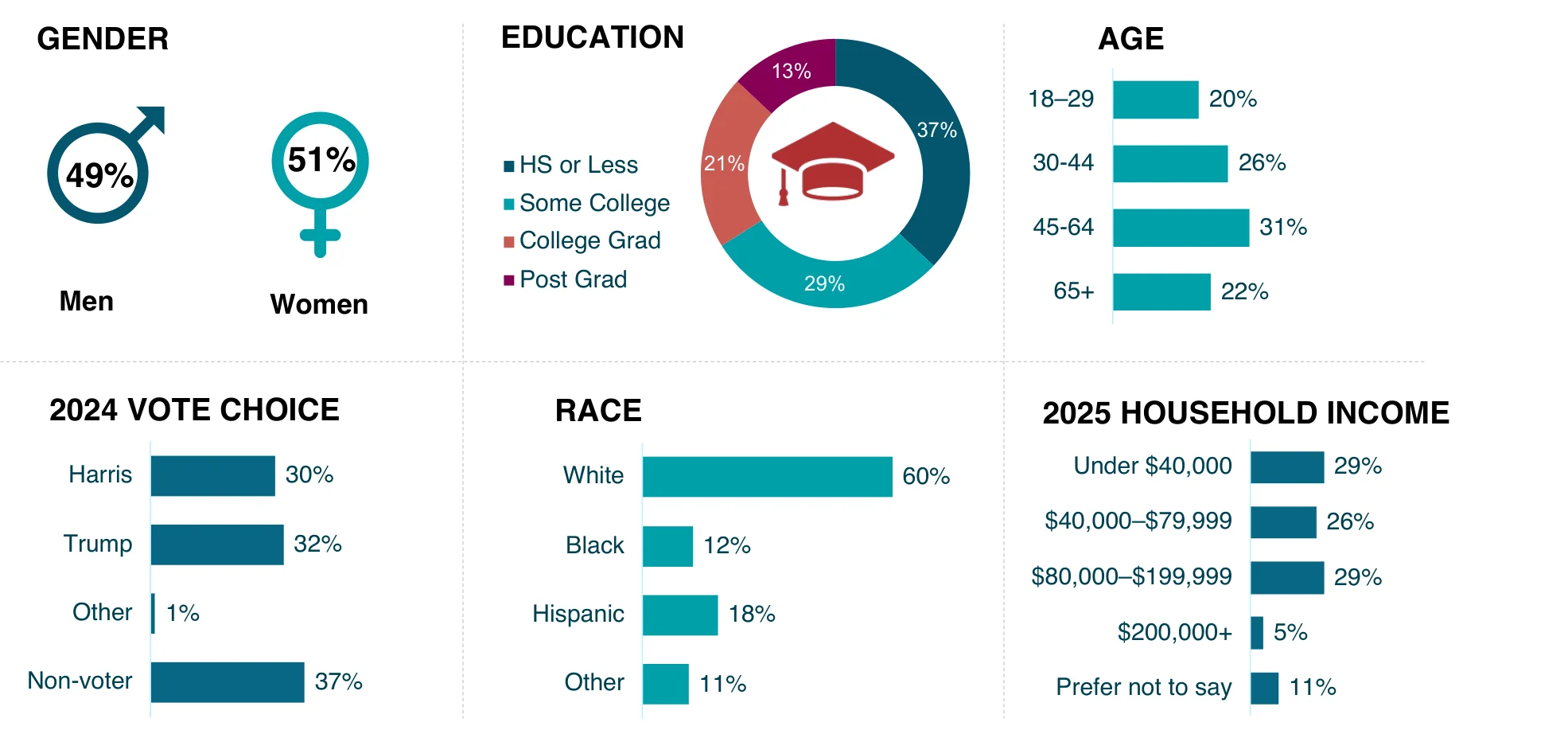
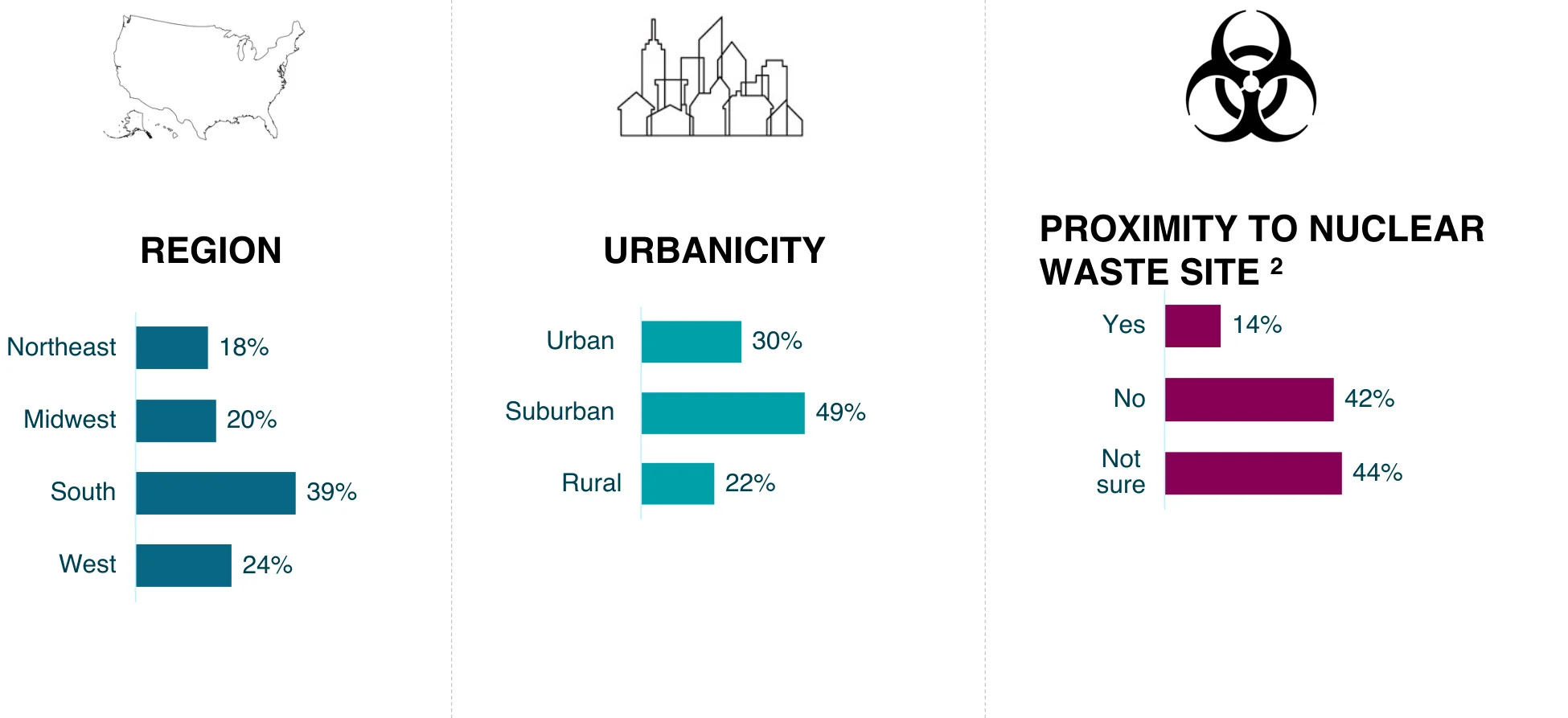
The survey was conducted between April 3 and April 8, 2026. YouGov interviewed 1,127 respondents, who were then matched down to a final sample of 1,000 U.S. adults.
The final dataset was weighted to be representative of the U.S. population, using demographic and political variables including age, gender, race, education, region, home ownership, and 2024 presidential vote choice.
The survey has a margin of error of ±3.7%.
Chart 1: US survey demographics
The research explored public views across several areas:
- familiarity with nuclear energy and radioactive waste management;
- attitudes toward nuclear power and its perceived benefits and risks;
- concerns about the lack of a permanent disposal solution;
- support for permanent disposal and deep underground disposal;
- perceptions of excavated repositories and deep borehole repositories; and
- how attitudes changed after respondents received information about different disposal technologies.
Chart 2: Regional composition and proximity to nuclear facilities
A key feature of the survey was its before-and-after information design. Respondents were first asked about their views based on their existing knowledge. They were then shown neutral, comparative information about excavated repositories and deep borehole repositories, including differences in depth, engineering approach, siting flexibility, safety concept, indicative cost, speed of implementation, and technology maturity. After reviewing this information, respondents were asked again about their views on the different disposal options.
This approach allowed the research to measure not only baseline public attitudes, but also how those attitudes evolved when respondents were given clear information about the technologies under consideration.
3 Public Attitudes Toward Nuclear Energy
3.1 Support for nuclear is broadly positive, but familiarity is limited
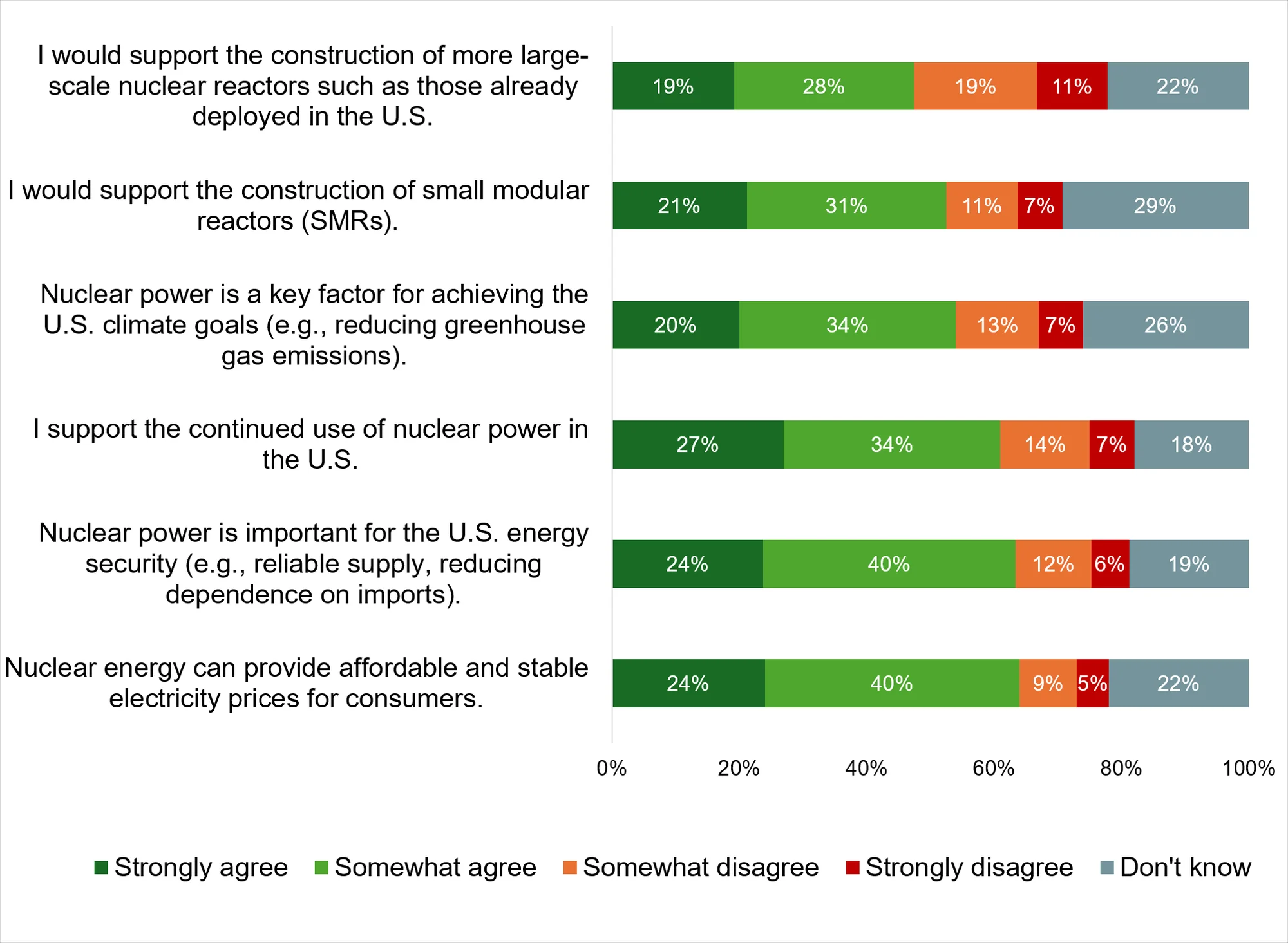
Americans express broadly positive views toward nuclear energy. 61% support the continued use of nuclear power in the United States, while similar numbers agree that nuclear energy is important for U.S. energy security and can provide affordable, stable electricity prices.
Chart 3: Americans associate nuclear energy with energy security and reliability
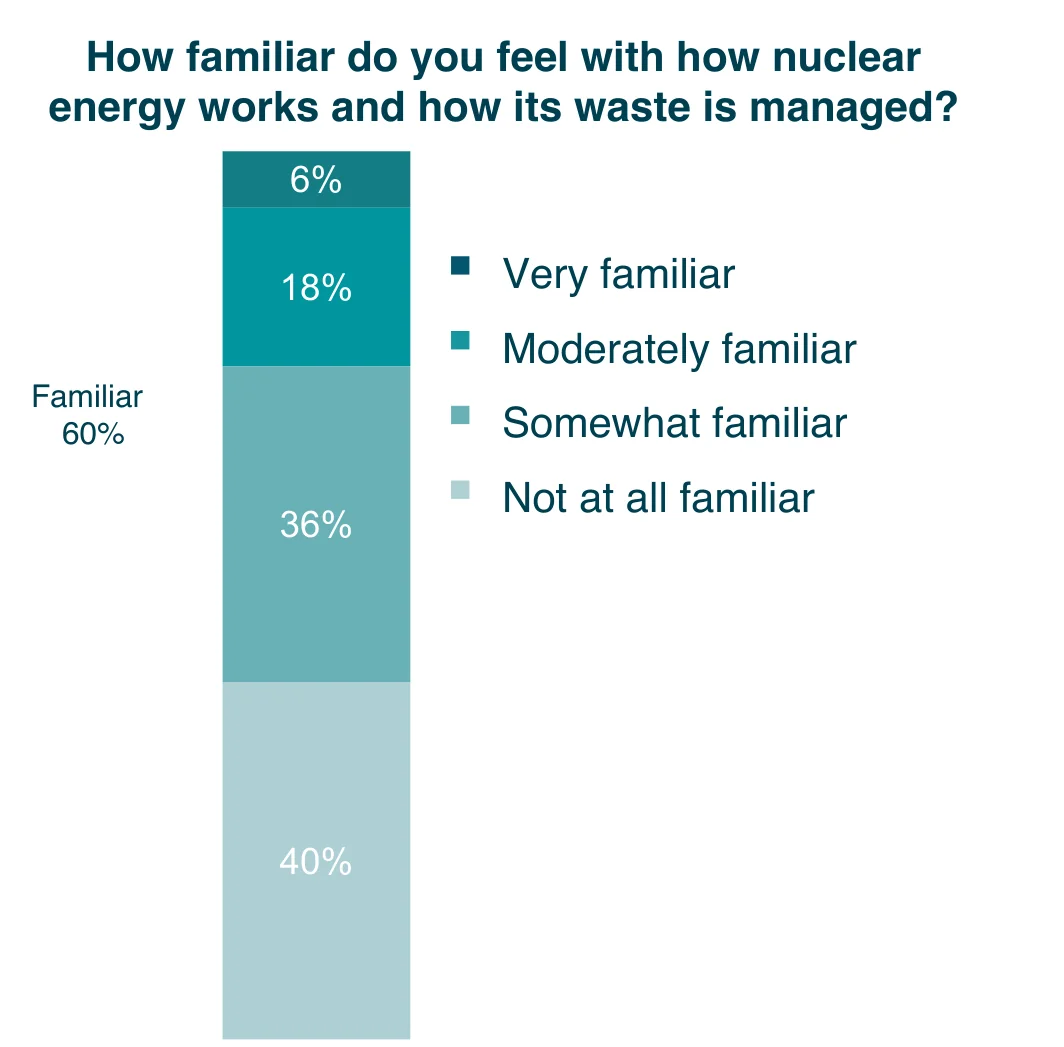
However, public familiarity with nuclear energy and radioactive waste management remains limited. Fewer than 25% of respondents say they are at least moderately familiar with how nuclear energy works and how its waste is managed. Respondents who reported greater familiarity with nuclear energy generally expressed stronger support for nuclear power and greater confidence in some disposal approaches.
Chart 4: Most Americans report limited familiarity with nuclear waste management
Together, these findings suggest that nuclear energy has a meaningful base of public support, but that public understanding of the fuel cycle and waste management remains limited. This creates both a communications challenge and an opportunity for clearer public engagement.
3.2 Concerns about accidents and radioactive waste remain strong
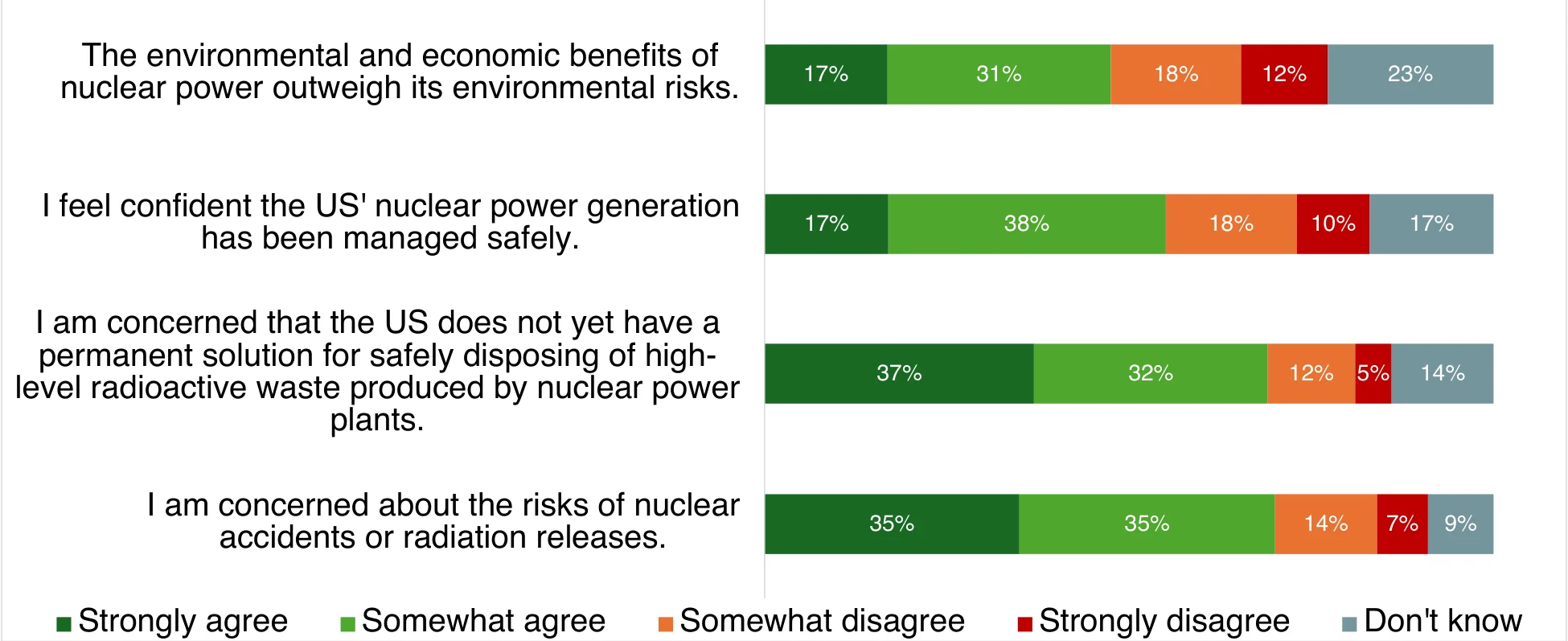
Although support for nuclear energy is strong, the survey shows concerns about nuclear accidents, radiation releases, and radioactive waste remain widespread.
70% of respondents express concern about nuclear accidents or radiation releases, while 69% are concerned that the United States does not yet have a permanent solution for safely disposing of high-level radioactive waste produced by nuclear power plants.
These concerns are central to how Americans evaluate nuclear energy. They suggest that public acceptance of nuclear power is closely connected to having confidence that radioactive waste can be managed safely, permanently, and transparently.
Chart 5: Safety and waste concerns remain high
4 Public Attitudes Toward Nuclear Waste Management
4.1 Americans want a permanent solution for nuclear waste
The survey shows strong public support for resolving the long-term management of used nuclear fuel and high-level radioactive waste.
81% of Americans agree that finding a permanent solution for high-level radioactive waste should be a national priority. By contrast, only 28% support continuing to store waste at reactor sites for many decades while leaving future generations to decide what to do.
Concern about the lack of a permanent waste solution is widespread. 69% of respondents express concern that the United States still lacks a permanent solution for high-level radioactive waste.
Chart 6: Permanent disposal is viewed as a national priority
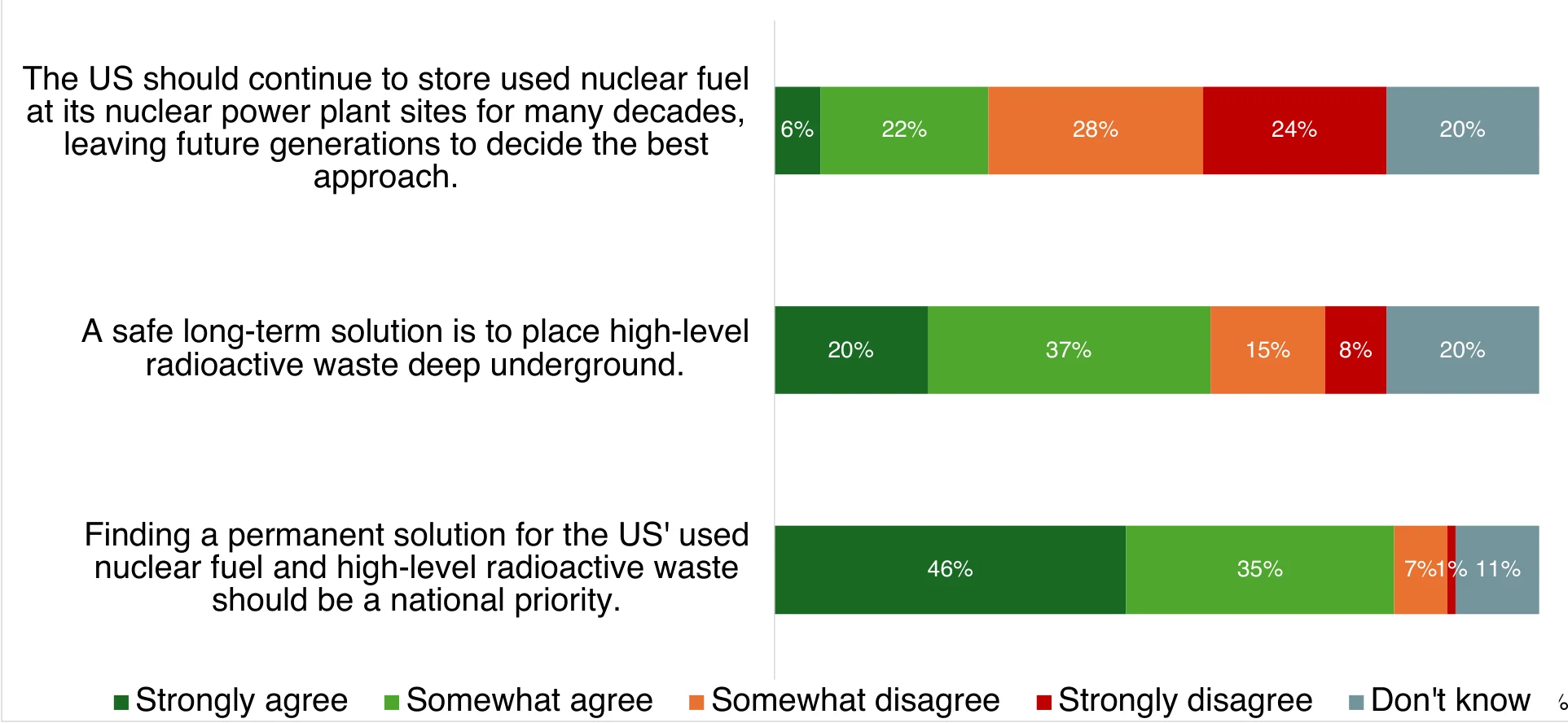
This finding is important because it suggests a clear public preference: the United States should not continue to rely indefinitely on interim storage. Respondents want a long-term disposal strategy that addresses the issue directly and responsibly.
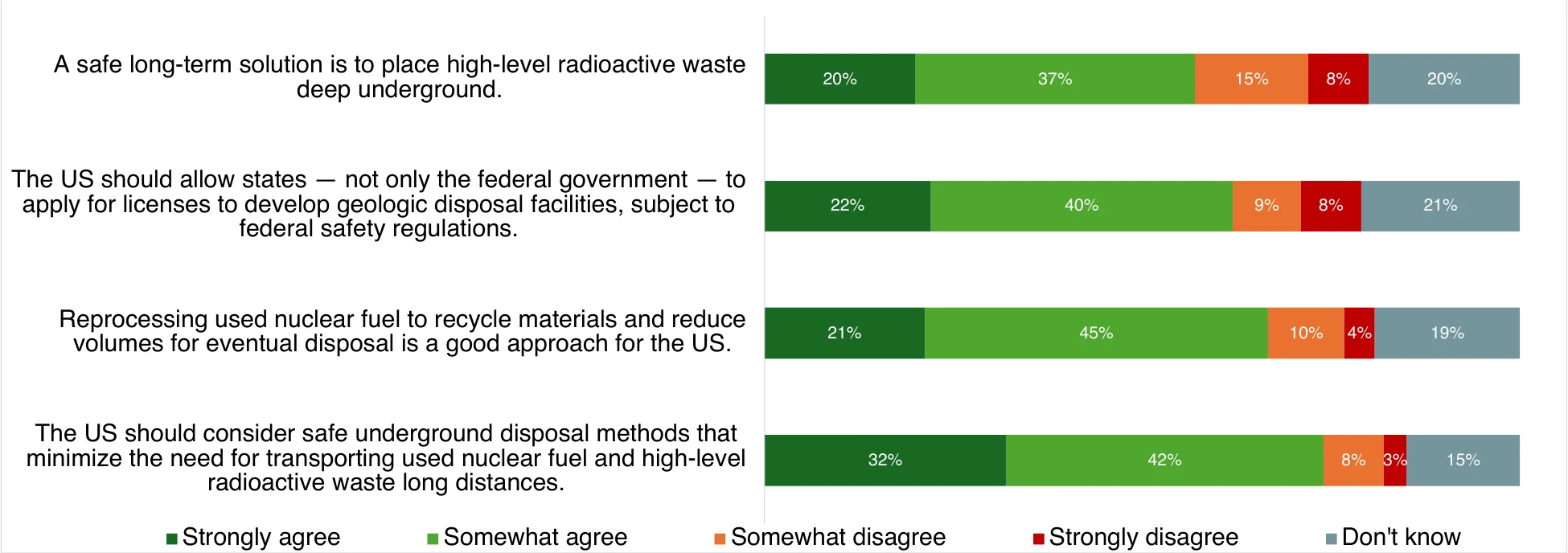
Support is strong for approaches that reduce the need to transport used nuclear fuel and high-level radioactive waste over long distances. 74% of respondents agree that the United States should consider safe underground disposal methods that minimize long-distance transportation.
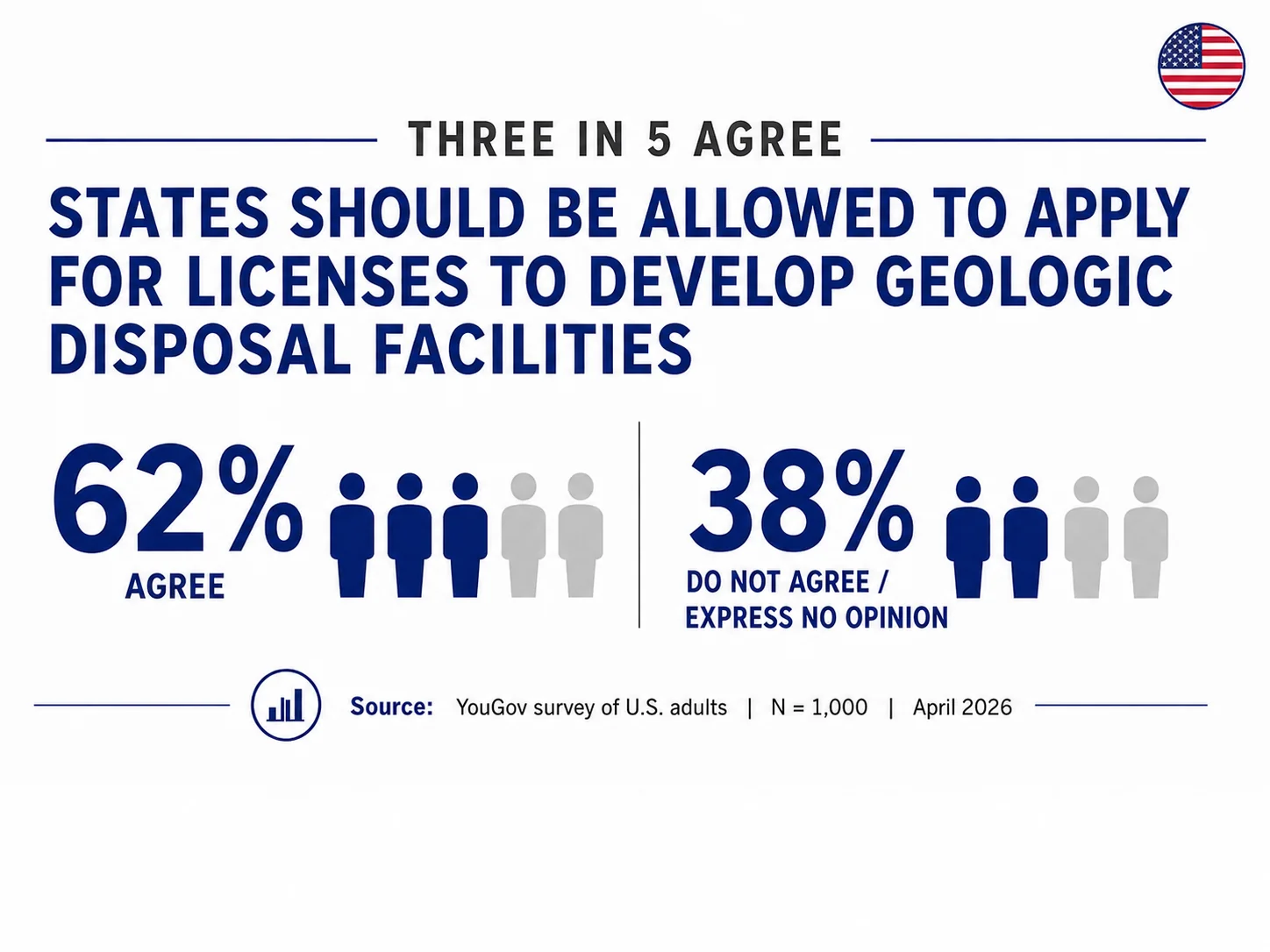
Respondents also show openness to a more distributed decision-making model. 62% agree that states should be allowed to apply for licenses to develop geologic disposal facilities, subject to federal safety regulations. This suggests that many Americans may be receptive to approaches that give states a clearer role, provided strong national safety standards remain in place.
The survey also finds majority support for reprocessing, although respondents appear to regard geological disposal as a necessary long-term requirement regardless of recycling approaches.
These findings point to a public preference for action, technical credibility, and long-term responsibility. Americans are not simply concerned about nuclear waste; they want a permanent pathway that reduces uncertainty, limits unnecessary transportation, gives states a meaningful role, and does not leave the burden to future generations.
Chart 7: Public Views on a Practical Nuclear Waste Disposal Plan
4.2 Attitudes toward geological disposal options
Before asking respondents to compare disposal options, YouGov presented them with information about two geological disposal approaches: excavated repositories and deep borehole repositories. The comparison covered typical depth, engineering approach, siting flexibility, safety concept, indicative cost, speed of implementation, and technology maturity. The survey also presented respondents with a simplified diagram illustrating the relative depth and configuration of excavated and borehole repositories.
After reviewing this information, respondents showed stronger support for disposal concepts based on deep geologic isolation than for shallower underground facilities designed to remain accessible to human workers. 57% of respondents agree that placing high-level radioactive waste deep underground is a safe long-term solution.
Chart 8: Deep borehole disposal receives stronger support than excavated repositories
Chart 8.1 – I trust American scientists and engineers to assist the government in selecting the best option for geologic disposal:
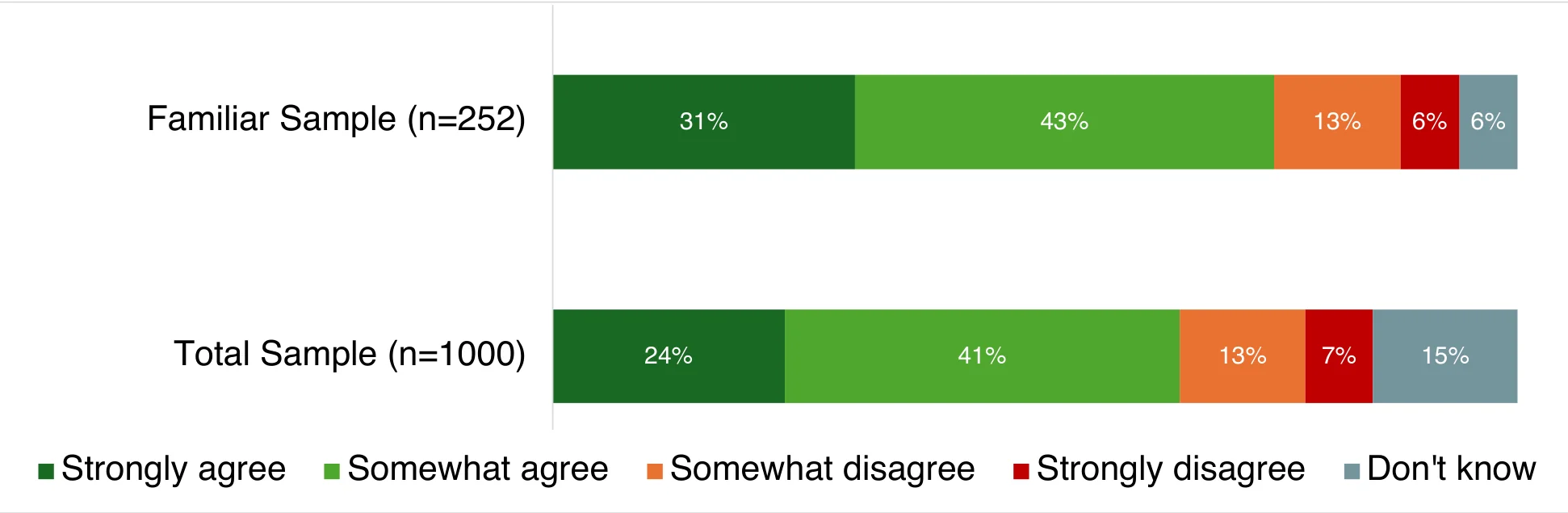
Chart 8.2 – It is safer to place high-level radioactive waste very deep underground in boreholes so that natural rock barriers keep it isolated without long-term reliance on engineered barriers:
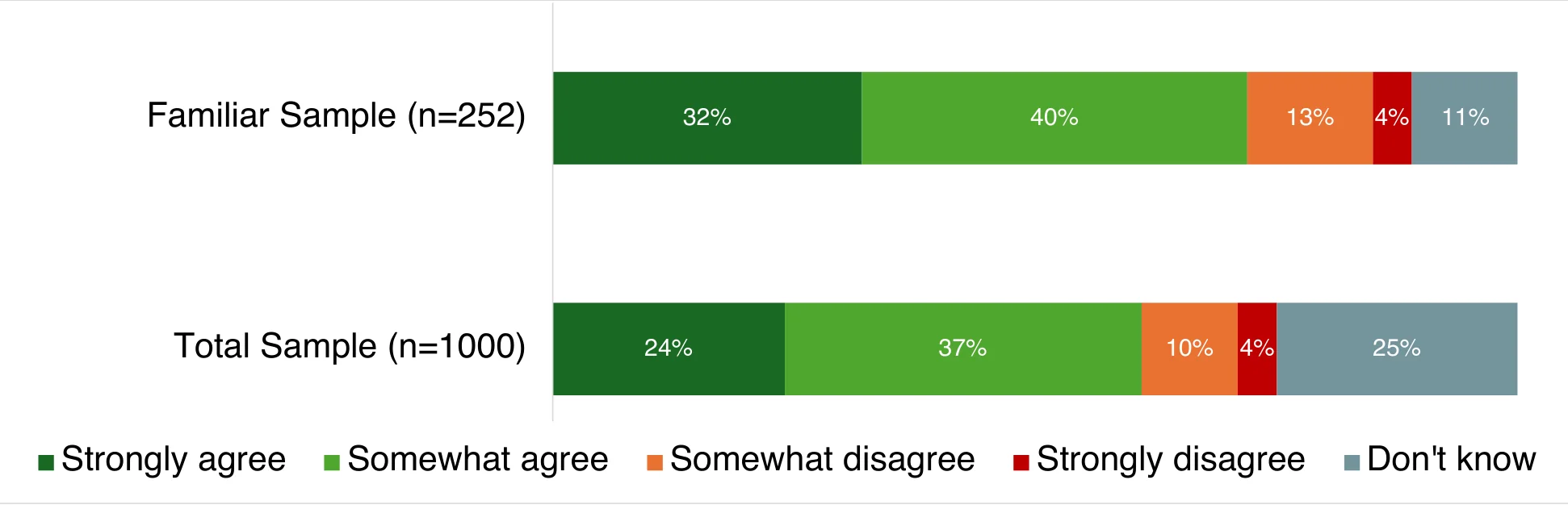
Chart 8.3 – If the US builds more reactors at new sites, I would prefer smaller repositories near the sites where radioactive waste is produced, rather than transporting the radioactive waste to a larger, centralized facility:
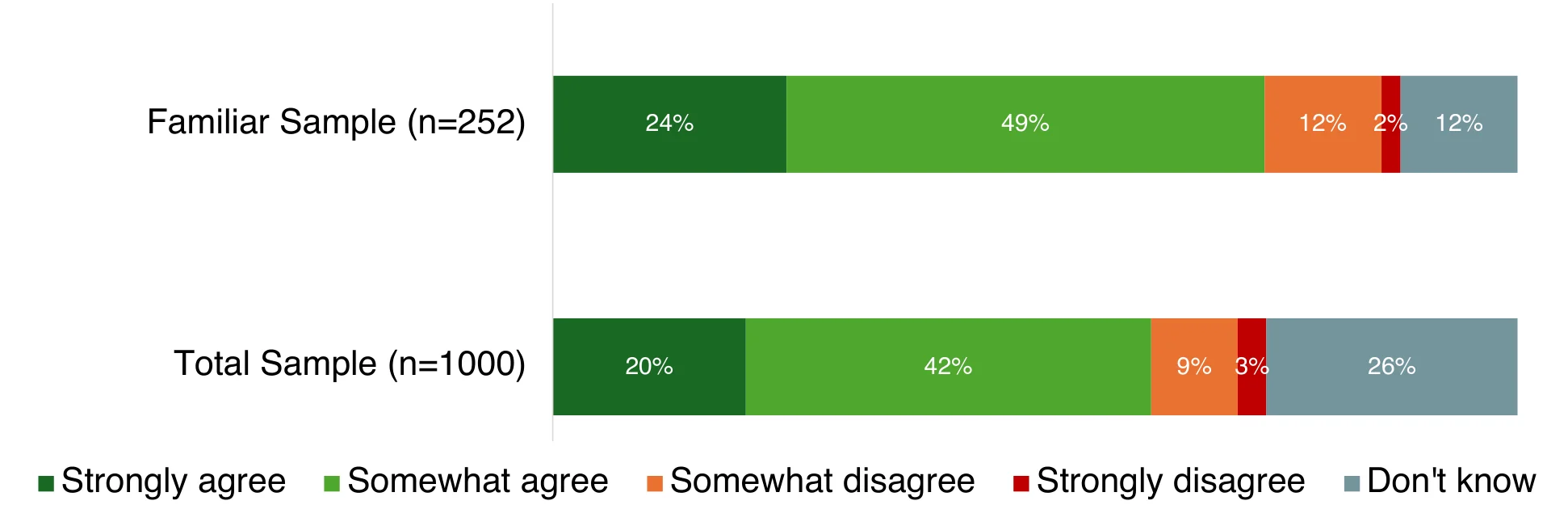
Chart 8.4 – It is safer to keep radioactive waste less deep underground in a watertight, breathable space where humans can have access to inspect it:
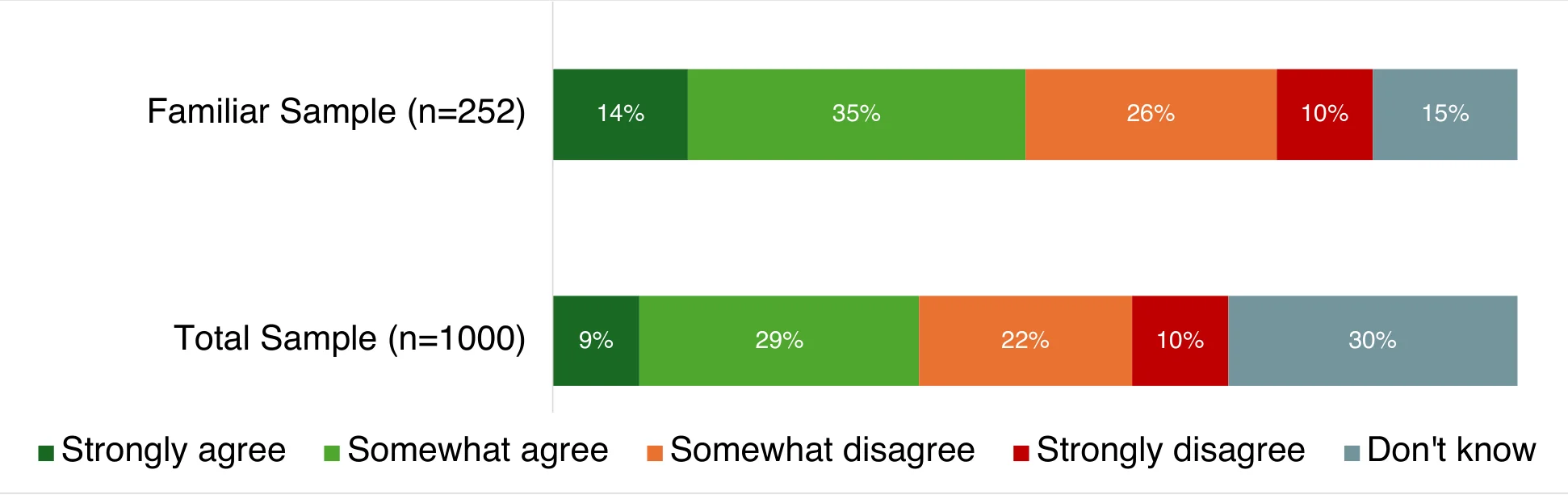
Respondents showed meaningful support for deep borehole disposal as a long-term waste management option. 61% agree that it is safer to place radioactive waste deep underground in boreholes where natural rock barriers isolate the waste without long-term reliance on engineered barriers. Only 38% agree that it is safer to keep radioactive waste at shallower depths in underground spaces accessible to human workers.
Support also exists for approaches that minimize transportation of used fuel and waste over long distances. 74% of respondents agree that the United States should consider underground disposal methods that reduce transportation requirements.
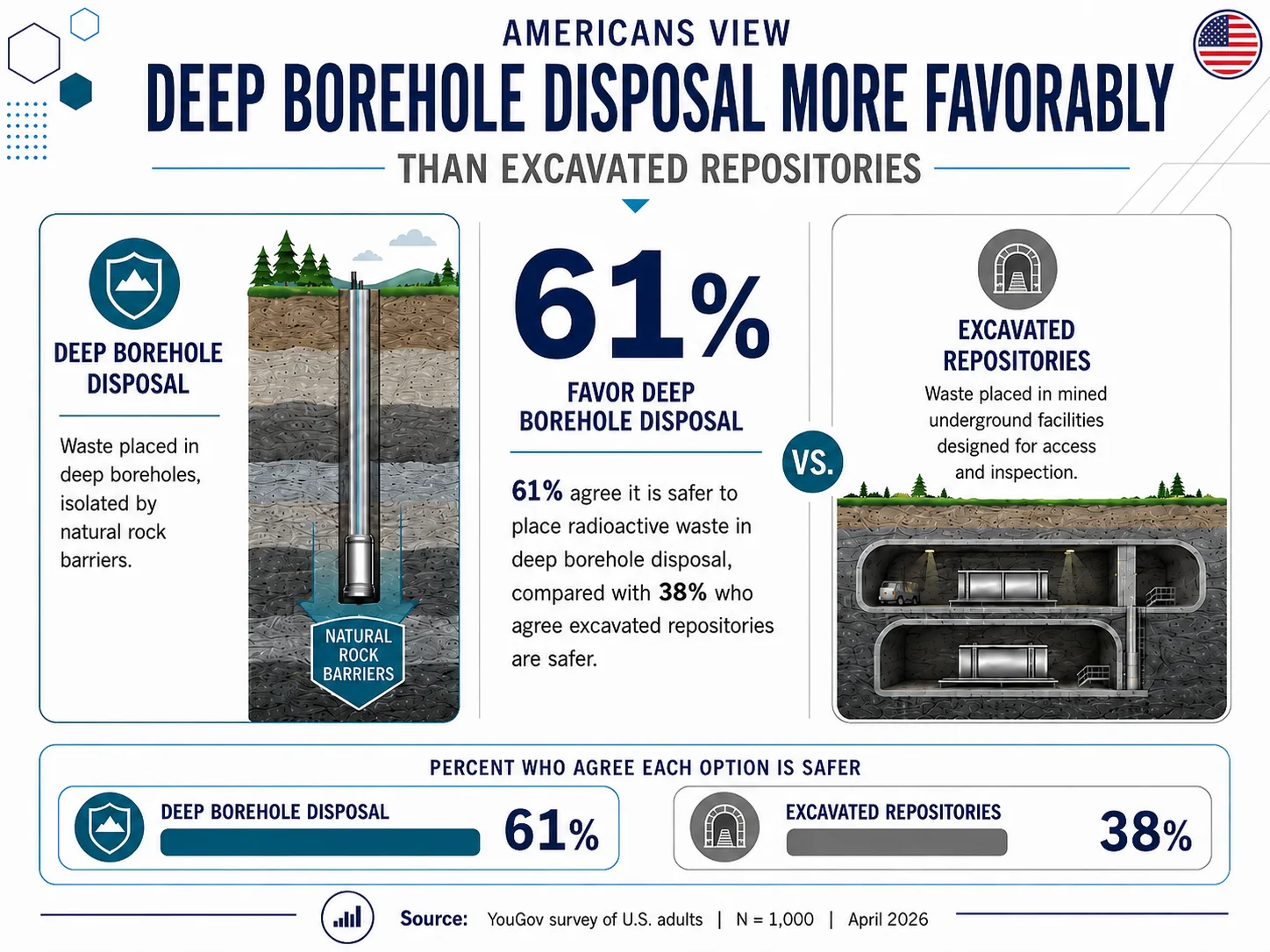
These findings indicate that many respondents are receptive to the core principles behind geological disposal: long-term isolation, reduced exposure at the surface, and limiting unnecessary transportation.
4.3 Support for borehole disposal grows with information and familiarity
One important finding is that support for deep borehole disposal increases after respondents receive objective, science-based information about disposal technologies.
Before reviewing comparative information, 58% of respondents agreed that a deep borehole repository would provide a safe and secure solution for U.S. high-level radioactive waste. After respondents reviewed information about excavated repositories and deep borehole repositories, support for deep borehole disposal increased to 65%.
The effect was even stronger among respondents who described themselves as at least moderately familiar with nuclear energy and waste management. Among this group, support for deep borehole repositories increased to 76% after information, from 66% before information.
By contrast, support for excavated repositories remained broadly unchanged.
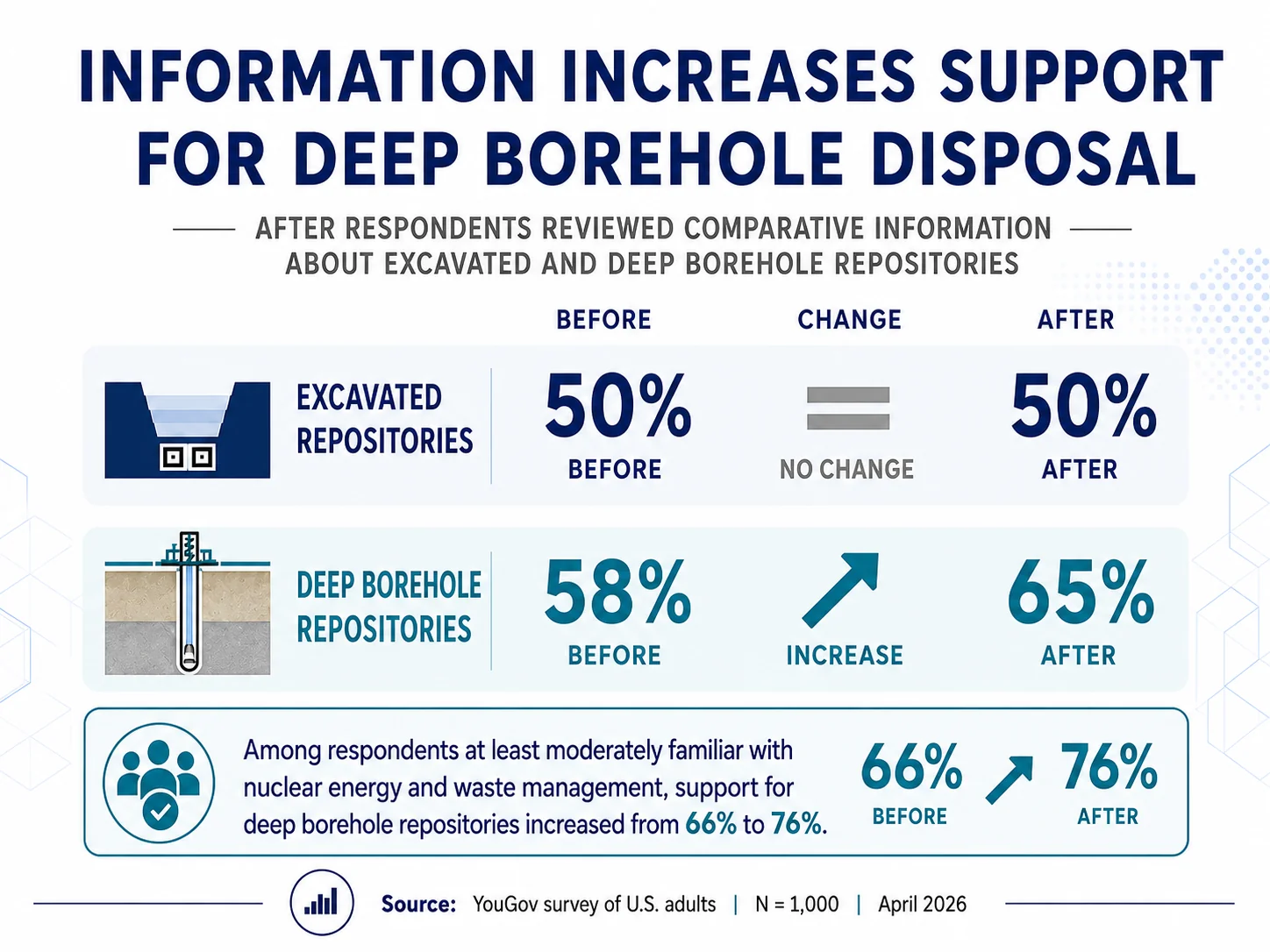
The findings indicate that informed public engagement may strengthen support for deep borehole disposal.
4.4 Trust is higher for scientists and engineers than government alone
The survey reveals a significant gap between trust in technical expertise and trust in government institutions.
68% of respondents trust scientists and engineers to assist the government in selecting the best waste management option.
By comparison, only 37% trust the U.S. government to make sound decisions about nuclear energy policy.
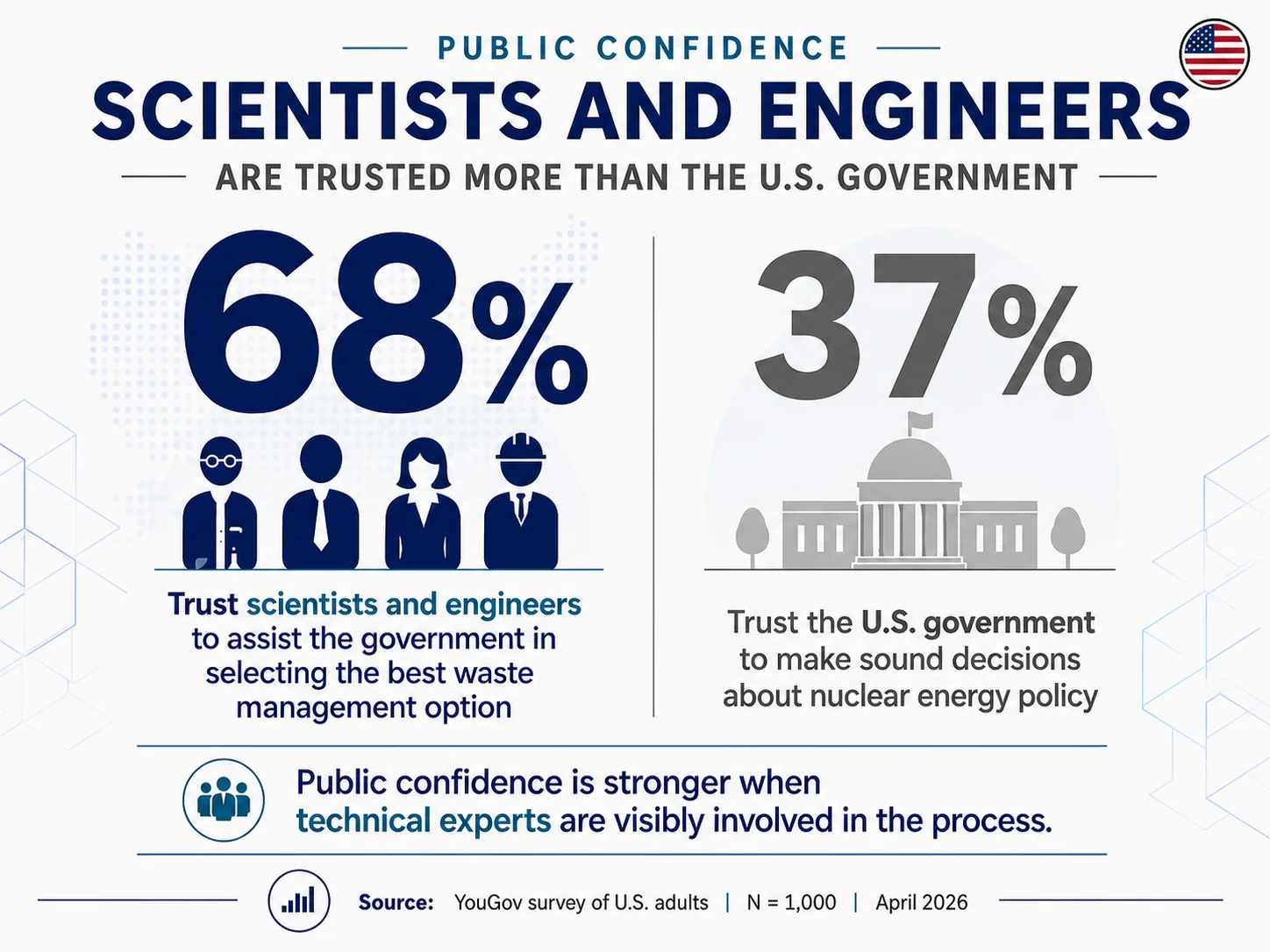
This gap matters for future nuclear waste policy. It suggests that public confidence may depend not only on the disposal technology itself, but also on who is seen as guiding the decision-making process. Respondents appear to place greater confidence in technical experts than in government acting alone.
The survey also shows support for a more distributed governance model. 62% agree that states should be allowed to apply for licenses to develop geologic disposal facilities, subject to federal safety regulations. This suggests that many Americans may be open to state-level participation, provided strong national safety standards remain in place.
4.5 Support is broad across regions and near nuclear sites
Support for permanent disposal and deep underground solutions is not confined to one part of the country. The survey found no statistically significant regional differences on several core measures, including support for finding a permanent solution, trust in scientists and engineers, and support for placing high-level radioactive waste deep underground.
This geographic consistency is important. It suggests that the desire for a permanent nuclear waste solution is broadly shared across regions.
The survey also examined respondents living near existing nuclear power plants. Among respondents living within 50 miles of a nuclear power plant, support for deep borehole repositories increased to 63% after information, from 58% before information. Uncertainty also declined across disposal approaches after information was provided.
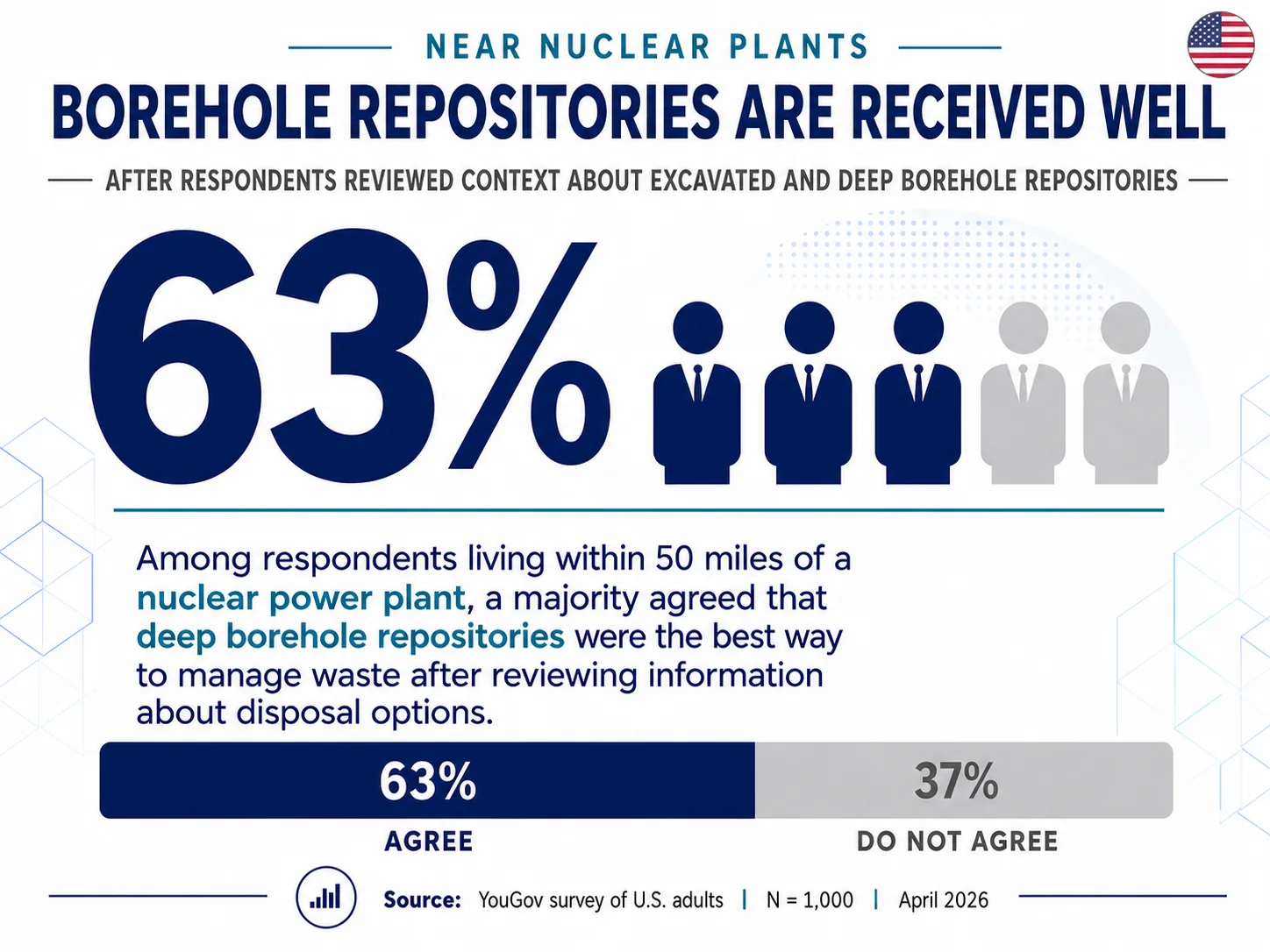
These findings show that support for permanent disposal can extend to communities near existing nuclear infrastructure, particularly when people are given clear information about the available options.
5 Implications for Policymakers and Industry
The survey findings show strong public support for moving beyond indefinite storage and toward a permanent disposal approach for used nuclear fuel and high-level radioactive waste. Respondents express concern about waste, but they also show support for practical approaches that emphasize safety, technical credibility, reduced transportation, and long-term responsibility.
First, the results point to a clear public preference for action. For policymakers, this suggests that continued delay may be less publicly acceptable than a well-explained strategy for progress.
Second, informed communication matters. Support for deep borehole disposal increased after respondents received information about different geological disposal options. This suggests that public engagement should focus on building understanding: explaining the waste challenge, the available disposal technologies, the safety concepts behind them, and the trade-offs involved.
Third, technical expertise is a major source of public confidence. Respondents place substantially more confidence in scientists and engineers than in government alone. This points to the importance of expert involvement, independent technical review, transparent decision-making, and visible safety oversight. Public confidence is likely to depend not only on the solution selected, but also on who is seen to be guiding and validating the process.
Fourth, the findings suggest public openness to more flexible and distributed approaches. Strong support for reducing long-distance transportation, combined with majority support for allowing states to apply for licenses to develop geologic disposal facilities subject to federal safety regulation, indicates that Americans may be receptive to models that give states a clearer role while preserving national safety standards.
Finally, nuclear communities should be part of the disposal conversation. Support for permanent disposal and deep underground solutions is not confined to one region of the country. Respondents living within 50 miles of a nuclear power plant were receptive to deep borehole repositories after receiving information about the technology. This suggests that communities already familiar with nuclear infrastructure may be open to constructive discussion about future disposal pathways, provided engagement is transparent, locally grounded, and focused on safety.
Taken together, the findings point to a practical path forward: a nuclear waste strategy grounded in permanent disposal, clear public communication, trusted technical expertise, strong federal safety standards, and meaningful engagement with states and communities.
Appendix: Survey Questions
Part 1: Attitudes Toward Nuclear Energy
How familiar do you feel with how nuclear energy works and how its waste is managed?
<1> Very familiar
<2> Moderately familiar
<3> Somewhat familiar
<4> Not at all familiar
Which energy sources, if any, do you think should play the largest role in replacing coal and other fossil fuels in the US? (Select all that apply)
<1> Solar
<2> Wind
<3> Nuclear
<4> Hydropower
<5> Natural gas
<6 fixed> Other (please specify)
<7 fixed, exclusive> I don’t think coal and other fossil fuels should be replaced
<7 fixed, exclusive> Don’t know
Nearly 20% of the United States’ electricity is generated by nuclear power. The US Department of Energy aims to increase the use of nuclear energy four-fold by 2050. Please indicate the extent to which you agree or disagree with the following ten statements:
(Strongly agree / Somewhat agree / Somewhat disagree / Strongly disagree / Don’t know)
- I support the continued use of nuclear power in the US.
- Nuclear power is a key factor for achieving the US’ climate goals (e.g. reducing greenhouse gas emissions).
- Nuclear power is important for the US’ energy security (e.g. reliable supply, reducing dependence on imports).
- Nuclear energy can provide affordable and stable electricity prices for consumers.
- I feel confident the US’ nuclear power generation has been managed safely.
- I would support the construction of more large-scale nuclear reactors such as those already deployed in the US.
- I would support the construction of small modular reactors (SMRs).
- The environmental and economic benefits of nuclear power outweigh its environmental risks.
- I am concerned about the risks of nuclear accidents or radiation releases.
- I am concerned that the US does not yet have a permanent solution for safely disposing of high-level radioactive waste produced by nuclear power plants.
Part 2: Attitudes Toward Radioactive Waste Management
As far as you know, how is used nuclear fuel and radioactive waste produced in US nuclear reactors managed? We are interested in what you know, please do not refer to outside sources.
[open box]
Include “Don’t know” checkbox
[proximity] Research by Columbia University (link) finds that over one third of Americans live within 50 miles of nuclear waste stored above ground. To your knowledge, are you one of those Americans, for example living near a nuclear power plant?
<1> Yes
<2> No
<3> Not sure
[BRIEF Description of the status quo in the US]. All countries using nuclear power must safely manage used nuclear fuel and high-level radioactive waste. Three main approaches exist. The forward arrow will appear shortly, please read each summary before continuing to the next:
- Long-term storage keeps radioactive waste in secure facilities at or near the surface for many decades, leaving it to future generations to decide whether to keep spending money on storage or to implement final disposal.
- Geologic disposal places radioactive waste deep underground in stable rock layers designed to isolate it permanently from the surface environment. The US’ Nuclear Waste Policy Act of 1982 designated deep geological disposal as the nation’s permanent solution for used nuclear fuel, and required the federal government to begin accepting waste from nuclear power plants for disposal by 1998. That deadline was not met, and no permanent geologic disposal facility for this waste has yet been built in the United States.
- Reprocessing separates usable materials (like uranium or plutonium) from waste so they can be recycled in reactors, reducing total waste volume. The US has historically not pursued reprocessing because of its high costs and safety concerns about the weaponizable plutonium that results. Importantly, reprocessing does not eliminate the need for future disposal: a smaller volume of high-level radioactive waste would remain and require geologic disposal.
Comprehension question
## “drag-and-drop” setup with two short definitions, and then the respondent has to correctly drag the method (I.e. geological disposal, long-term storage) to the correct definition.
## respondents must answer correctly to move forward. After their first failed attempt they are asked to try again, after the second failed attempt, they are given the answer and asked to select it before continuing. They must select the correct answer to move forward.
- Geologic disposal: Buries radioactive waste deep underground in stable rock formations for safe, permanent isolation from the environment.
- Long-term storage: Keeps radioactive waste securely stored at or near the surface for decades, postponing a final disposal decision for the future.
- Reprocessing: Aims to re-use valuable materials from used nuclear fuel and reduce the volume that needs permanent disposal.
Please indicate the extent to which you agree or disagree with the following eight statements:
(Strongly agree / Somewhat agree / Somewhat disagree / Strongly disagree / Don’t know)
- Finding a permanent solution for the US’ used nuclear fuel and high-level radioactive waste should be a national priority.
- Reprocessing used nuclear fuel to recycle materials and reduce volumes for eventual disposal is a good approach for the US.
- I trust American scientists and engineers to assist the government in selecting the best high-level radioactive waste management option.
- A safe long-term solution is to place high-level radioactive waste deep underground.
- The US should continue to store used nuclear fuel at its nuclear power plant sites for many decades, leaving future generations to decide the best approach.
- The US should consider safe underground disposal methods that minimize the need for transporting used nuclear fuel and high-level radioactive waste long distances.
- I trust the US government to make sound decisions about nuclear energy policy.
- The US should allow states — not only the federal government — to apply for licenses to develop geologic disposal facilities, subject to federal safety regulations.
Part 3: Attitudes Toward Different Types of Geologic Disposal
There are two main types of geologic disposal being considered globally. Both are designed to isolate radioactive waste deep underground in stable rock formations for hundreds of thousands of years, but they differ in technology, depth, and engineering approach. The forward arrow will appear shortly, please read each summary before continuing to the next:
[randomize order]
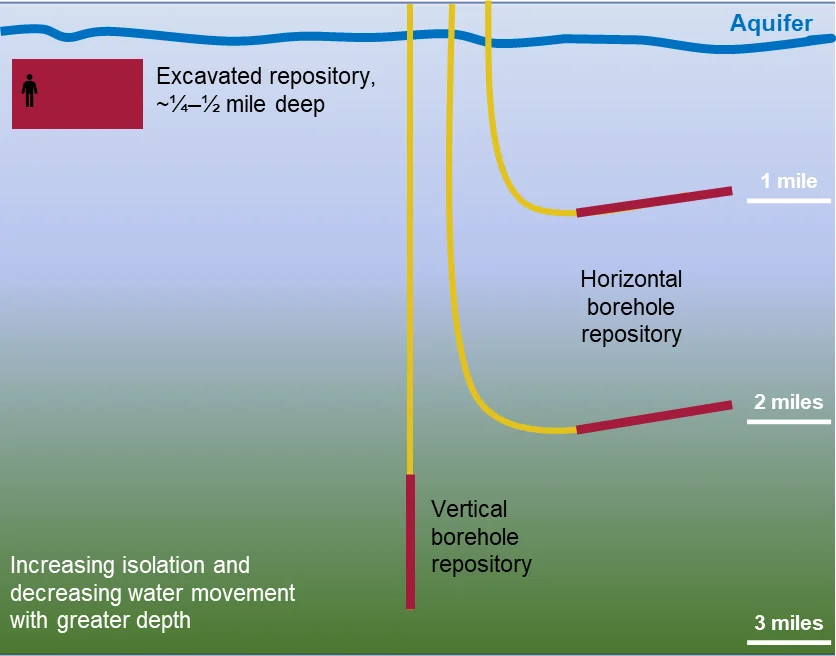
The [first/second], “Excavated Repository,” would use mining technology to excavate a specially-designed, waterproof, underground place where workers can access and work to store radioactive waste, typically about one-quarter to one-half mile deep. No country yet operates a facility like this, but one has been constructed and may receive a license to begin operation in Finland later this year.
The [second/first], “Deep Borehole Repository,” would use drilling technology developed in the oil and gas industries to emplace radioactive waste 3,300 feet to 3 miles or more underground in narrow boreholes drilled into isolated rock formations that are not accessible to human workers. No country yet operates a facility like this, but a nonradioactive demonstration facility is being constructed in Texas this year.
No final decision has been made about the best approach to adopt in the US. A simplified, not-to-scale illustration of the two approaches is here:
Please indicate the extent to which you agree or disagree with the following three statements:
(Strongly agree / Somewhat agree / Somewhat disagree / Strongly disagree/ Don’t know)
- An excavated repository would provide a safe and secure solution for the US’ high-level radioactive waste.
- A deep borehole repository would provide a safe and secure solution for the US’ high-level radioactive waste.
- A combination of these two technologies, as determined by American experts and regulators, would provide a safe and secure solution for the US’ high-level radioactive waste.
For the next part of the survey, we will show several considerations for both approaches. Please read each carefully and answer the questions that follow based on how you feel about the information. The forward arrow will appear shortly.
| Aspect | Excavated Repository | Deep Borehole Repository |
|---|---|---|
| Typical Depth | Generally about one-quarter to one-half mile deep. | Generally about 1–3 miles deep or more. |
| Technology | Uses mining technology to excavate large, water-proof, ventilated spaces that will support human workers underground. Cannot re-use existing mines. | Uses oil and gas drilling technology to create narrow boreholes (tailored to the diameter of radioactive waste forms) that are filled with fluid and are managed entirely from the surface. Cannot re-use existing boreholes. |
| Siting | Requires identifying specific rock formations that can be safely mined and engineered for long-term stability. Suitable sites are typically concentrated in only a few regions. | Can be implemented in a wide range of geologic settings because directional drilling allows access to deep, stable rock formations at variable locations, increasing the number of technically suitable sites that could be considered. |
| Safety Concept | Relies on a combination of engineered barriers (such as metal canisters and bentonite clay) and the surrounding host rock to isolate waste. | Relies on the depth and the natural integrity of a greater volume of surrounding rock to isolate waste, with no long-term reliance on engineered barriers. |
| Indicative Cost (international benchmarks) | Generally estimated at around $1.2 million per ton. | Generally estimated at less than $0.5 million per ton. |
| Speed of Implementation | Requires civil works and central infrastructure; after site licensing, repository construction can take about a decade. | Can be developed modularly; after site licensing, each borehole can be constructed and begin emplacement operations within weeks. |
| Technology Maturity | More mature: not yet operational in any country; Finland has constructed the first such mined repository at Olkiluoto and aims to begin disposal operations after regulatory approval expected in 2026. | Less mature: not yet operational in any country; a small-scale deep borehole repository has been demonstrated in Texas, USA, and a full-scale, at-depth nonradioactive demonstration is planned for early 2027. |
In light of this further information, please indicate again the extent to which you agree or disagree with the same statements:
(Strongly agree / Somewhat agree / Somewhat disagree / Strongly disagree / Don’t know)
- An excavated repository would provide a safe and secure solution for the US’ high-level radioactive waste.
- A deep borehole repository would provide a safe and secure solution for the US’ high-level radioactive waste.
- <fixed> A combination of these two technologies, as determined by American experts and regulators, would provide a safe and secure solution for the US’ high-level radioactive waste.
Please indicate the extent to which you agree or disagree with these four statements:
(Strongly agree / Somewhat agree / Somewhat disagree / Strongly disagree / Don’t know)
- I trust American scientists and engineers to assist the government in selecting the best option for geologic disposal.
- If the US builds more reactors at new sites, I would prefer smaller repositories near the sites where radioactive waste is produced, rather than transporting the radioactive waste to a larger, centralized facility.
- It is safer to place high-level radioactive waste very deep underground in boreholes so that natural rock barriers keep it isolated without long-term reliance on engineered barriers.
- It is safer to keep radioactive waste less deep underground in a watertight, breathable space where humans can have access to inspect it.
Do you have any other comments or questions about options for geologic disposal of high-level radioactive waste, such as excavated repositories or deep borehole repositories?
Lastly, we’d like to ask a few questions about you.
Demographics post-survey: industry, urbanicity, marital status, employment status, household income, child under 18, party ID, voter registration status, ideology, news interest.