All episodes of The Nuclear Waste Story
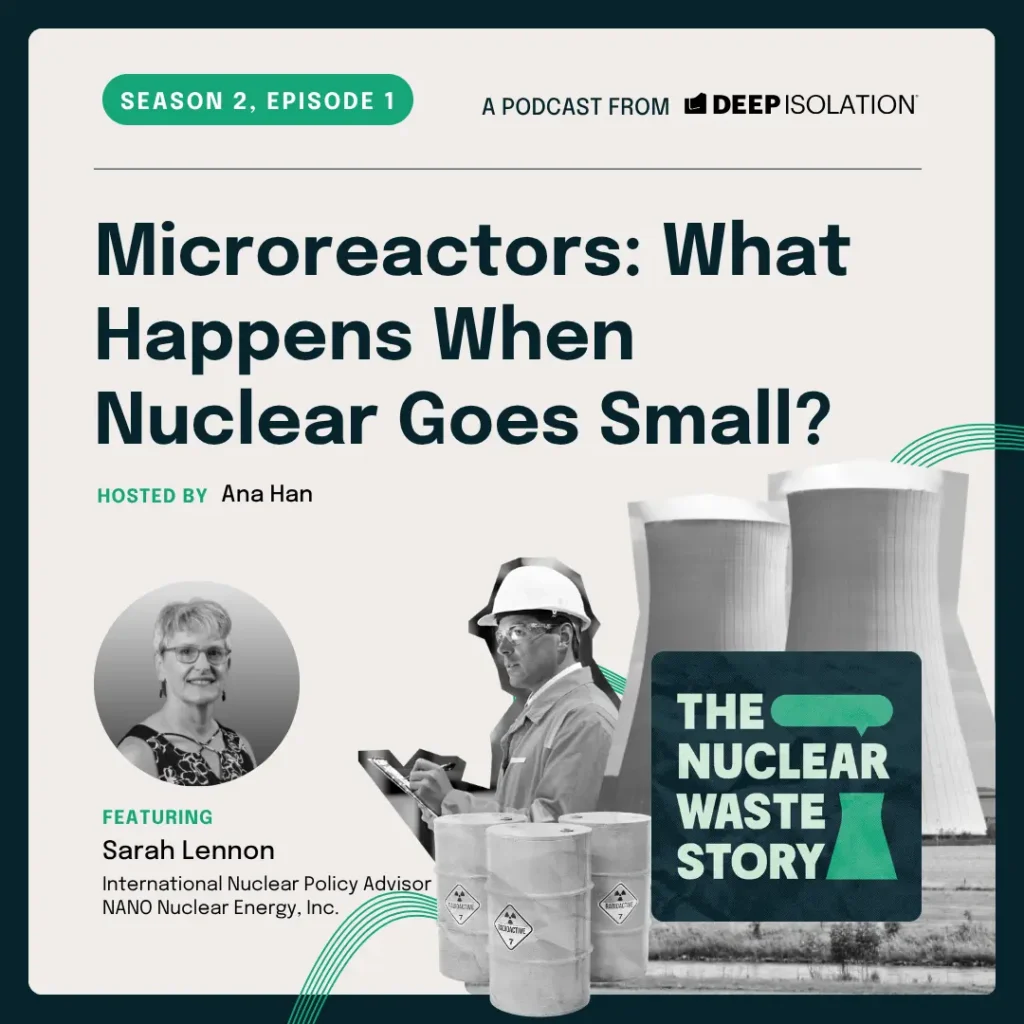
The Nuclear Waste Story Season 2 · Season 2, Episode 1
Microreactors: What Happens When Nuclear Goes Small?
- Featuring Sarah Lennon International Nuclear Policy Advisor at NANO Nuclear Energy
“They're not your grandfather's nuclear power plant.” Microreactors could change where and how we use nuclear energy. Sarah Lennon of NANO Nuclear Energy joins us to explore what makes these reactors different, how they could bring reliable power to remote communities, and what happens to the nuclear waste they produce.
Also listen on
Transcript
Note: This transcript is the raw transcript of this podcast. Minimal edits have been made only for clarity purposes.
Introduction
Karen (00:01)
When you think of nuclear power, you probably picture a giant power plant with cooling towers and enough electricity to power an entire city. And for the most part, that’s exactly what nuclear energy looks like in the United States today. Big reactors connected to the electric grid. But what if nuclear power didn’t have to look like that? What if a reactor could provide electricity to a remote island, power a hospital, or bring reliable energy to communities without access to a grid?
That’s where micro reactors come in. These smaller advanced nuclear reactors are being developed to do things that the traditional nuclear feat just wasn’t designed to do. And with a growing number of companies working to bring them to market, they could change how we think about nuclear power and where it fits into our lives. But how exactly do they work? And what makes them different from today’s reactors? And what happens to the nuclear waste that they produce? Today’s guest is Sarah Lennon of Nano Nuclear Energy.
After 30 years of working in the US government of non-nuclear energy and national security, Sarah moved into the private sector to help advance the next generation of nuclear technology.
01:31 Introduction to Micro Reactors and Guest Sarah Lennon
Ana Han (01:32)
Well, welcome Sarah Lennon. to our episode on Microreactors: What Happens When Nuclear Goes Small. I would like to start just by introducing myself. and my name is Ana Han. I’m with Deep Isolation, I’m the business development and government affairs lead, and I feel so lucky to introduce my colleague from when we worked together in the US Department of Energy and now working for NANO Nuclear, she has an extensive resume. I could read the whole entire page, page and a half, but I’ll just give a little blurb on Sarah. Sarah spent 30 years in the US government holding senior positions at Department of Energy, Department of State and national nuclear security administration and earlier this year she transitioned to the private sector, joined NANO to focus on international nuclear policy and cooperation. Welcome Sarah to our podcast.
02:32 Sarah Lennon’s Journey in Nuclear Energy
Sarah Lennon (02:32)
Thank you, Ana. I’m excited to be here. and to talk about micro reactors and all the good things that they can bring.
Ana Han (02:39)
Yes, I mean you’ve spent 30 years in the US government, like I said, working in nuclear energy and national security, in non-proliferation, in international collaboration. We were lucky enough to work a couple of years together doing that, which was really, really exciting. But I wanted to ask you, looking back at those experiences, what shaped your perspective on nuclear energy and what lessons from government are you bringing now to the private sector?
Sarah Lennon (03:05)
Thanks, Ana. So I would say, you know, I started out in the nuclear security threat reduction world, did non-proliferation for many years, did some counterterrorism work trying to prevent WMB terrorism. But I think when I s moved from the non-proliferation world to the Office of Nuclear Energy at the Department of Energy, that’s where I really saw the potential for nuclear energy. And when I was in the NE office, it was before this new newest nuclear renaissance and we weren’t able to really move forward. We weren’t building anything and at the same time, we were shifting from an era of cooperation with Russia on a number of areas to the post-2014 and Russian invasion. And so I saw nuclear energy as really a way for the US to sort of project power and project its positive influence globally. And then I worked on a project called the Nuclear Innovation Clean Energy Initiative. so the NICE Future Initiative under the Clean Energy Ministerial. And that’s really where I started learning about nuclear and the clean energy world. So I’d say that was the biggest piece.
Ana Han (04:20)
Yes, that’s great. I think together we have been lucky to see the ups and downs of the nuclear renaissance. And now it’s so interesting to see the partnerships that are being developed between industry and government. Maybe we didn’t see that as much as we did in the last 10 years.
04:45 The Evolution of Nuclear Partnerships
Sarah Lennon (04:45)
Absolutely. It amazes me. When I was in the Office of Nuclear Energy, I occasionally had meetings with some private sector companies, but it was rare. and it was not something that we did frequently. And so now the partnerships, as you mentioned, between DOE and providing funding and support and new programs to help US companies really move the ball forwards, I think is amazing. It’s a different environment.
Ana Han (05:13)
Is that what attracted you to NANO Nuclear Energy, just that excitement about being able to kind of continue your work but wearing a different hat?
Sarah Lennon (05:22)
Yeah. So I was introduced to NANO Nuclear late spring, early summer, I think last year, from a colleague who I had worked with over the years and she was now working with NANO. And the fact that it was such a young company, only you know the initial IPO was in 2014. So it was young, it’s agile, small, and just things move so quickly. And I think that’s really one of the things that appealed to me after working for 30 years in the US government, which I absolutely loved. I feel like I was so fortunate to have the career that I did in all the different parts of the government. But being able to jump into something and really make a difference, bringing my experience working with other countries and the interagency, the different departments and agencies in the US government, I felt like I could really make a difference and help them out.
Ana Han (06:18)
Yes, and definitely another big change that I’ve noticed is, you know, now we’re talking micro reactors and these advanced reactors are coming up and all these organizations and companies are coming up with these incredible ideas. But when you think about it, it’s not just recently coming up. This has been in development for years and years and years. People think that, you know, all of a sudden NANO just stood up and no, but
06:42 Understanding Micro Reactors
Ana Han (06:42)
this has been going on. It seems that right now with the support of the federal, the state, and all these really incredible initiatives, it’s seeing it from another lens, right?
Sarah Lennon (06:55)
What’s interesting is the technology that Nano is using for its Kronos reactor, our flagship reactor, was initially demonstrated in the 1960s.
07:06 Safety and Innovation in Micro Reactors
Ana Han (07:06)
That’s why I like this podcast and I wanted to do it because I think the more that people realize that a lot of these technologies have been in the pipeline for awhile and now we’re looking at commercializing them. So what can you tell our listeners about what a microreactor is? How does it differ from a traditional nuclear reactor? When we worked in the Office of Nuclear Energy, I remember it was the Gen 4, you know, the big 1000 AP 1000 Westinghouse. But now what is the difference between a microreactor and a traditional nuclear reactor?
Sarah Lennon (07:43)
So I would say, you know, the traditional light water reactors were around the 1,000 megawatt size, give or take. Micro reactors are generally under 20 megawatts electric, sometimes up to 50 megawatts electric, but I think the NRC definition is really 20 megawatts and under. It uses a different kind of fuel, and there are a number of different kinds of fuel for these advanced reactors, so they are a lot safer. And I will talk about that a little bit more. But what I think really makes a difference is that these smaller reactors, you don’t need to connect them to a grid. So there’s a lot more adaptability and flexibility to provide energy, electricity, heat, steam to areas that you couldn’t that couldn’t use nuclear energy if it had to be a large one-thousand-megawatt reactor with a huge emergency planning zone. with at least the Kronos reactor, there is no emergency planning zone. so it can fit anywhere pretty much.
Ana Han (08:52)
That’s incredible. And I’m glad that you mentioned safety because you know, there’s been a lot of pushback with the executive orders from the president and all the advancements and people kind of say, you know, maybe it’s going so, so fast and safety is kind of being forgotten. But when you listen to the NRC and you listen to the Department of Energy and you listen to companies like yours, safety is not something that you forget about, right?
Sarah Lennon (09:21)
No, no, absolutely not. And I think the two pieces to my answer is one with what the NRC is doing is revising the requirements so that they’re based on the new kinds of reactors. So it’s not just checking the box for every answer because there is no EPZ or you have a different kind of fuel. So a lot of the paperwork was just reduced and streamlined. The NRC will never license anything that is not safe. I mean, the NRC is the gold standard globally and that’s why they have such a great program internationally, helping other countries develop their own regulatory standards and their frameworks. and in terms of safety, I can only speak specifically to NANO’s reactor, the Kronos reactor, but I mean the safety case for the Kronos reactor has five main points. One, if there is a loss of power, it will automatically shut down. No humans needed to do anything. It has passive cooling, so that it is designed to the helium coolant is non-reactive, so it it will not overheat. it has what’s called a negative temperature coefficient, and again, I think you know this. I’m not an engineer, so I know the good terminology, but it’s this negative temperature coefficient, which basically means the reactor is designed specifically to resist overheating, to prevent any problems, and then the fuel that our reactor uses is called TRISO fuel, and it cannot melt down. The fuel is coated and it’s in graphite blocks so that it cannot meltdown should anything happen, even though the three things that I already mentioned before that would not result in an instance where there might be melting, but it cannot melt. And then finally, the coolant that the Kronos reactor uses is helium, which is not water. So it cannot become radioactive, it cannot corrode comb components, and there’s no contaminated steam possibility. So those five things kind of we believe that pretty much guarantees that it is a safe reactor. And it’s being built on a college campus, in at the University of Illinois. Literally like stones’ throw from a dorm. So we’re pretty confident.
11:50 Micro Reactors and Global Energy Access
Ana Han (11:50)
Yeah, I think people forget how safe nuclear is, you know, not to say the Simpsons or anything like that, but it’s totally the opposite of that. The nuclear industry in the US has been one of the safest. But it segues to my next question on international, you had mentioned that you were very passionate about the potential for microreactors to bring reliability, electricity, reliability to remote communities, including islands in the Southeast Asia and underserved regions of Africa. Can you share your vision to with our listeners of what this is for you?
Sarah Lennon (12:29)
Sure. yeah, I was very fortunate in early on in my career with NANO, I think like three months after I joined the company, I went to a conference in Rwanda. It was my first trip to Africa, and it was the Nuclear Innovation, Nuclear Energy Innovation Summit for Africa or NISA. And it was just amazing, all the presentation and the discussions by the youth of Africa. I mean, they were there in force. And talking about how this was so important to their futures to bring electricity to underserved regions where there is no grid or where there’s only a small power need so that they might be able to have water or power their homes or provide jobs. And you can’t do that with large nuclear. So that was really eye-opening for me. And then I went to Singapore in June and talked to Singaporeans and also some Philippine companies, including just yesterday. And there are so many islands, especially you know, Philippines and Indonesia, and they rely on diesel, which is polluting and the idea about being able to power a hospital or a school and a remote island somewhere so that kids can have an education or you have healthcare powered by these advanced nuclear reactors, I think is just amazing. And so that’s what I’m really passionate about is making a difference.
Ana Han (13:59)
Yeah, and nuclear is clean, you know. but not only that, but for these remote regions that are in dire need of electricity, it provides that chance. There’s not much you can do if you don’t have energy. So I feel as the US continues to grow in the technology of microreactors, we want to be out there, right? We don’t want everything to be coming from other countries that maybe then these smaller economies and countries are relying upon, right? We want to make sure that the US technology, nuclear technology is out there and that we’re supporting this growth.
Sarah Lennon (14:37)
Right. It’s that hundred-year commitments, when you sign a contract for a nuclear reactor, or the analogy I keep hearing everywhere I go is it’s like a marriage or a hundred year hug, somebody referenced yesterday.
Ana Han (14:47)
It’s like marriage. I like that. A hundred-year hug. I like that. Yes.
Sarah Lennon (14:55)
We want to make sure that the safest technology, which we believe is ours, US, I’m saying, not just NANO in this case.
Ana Han (15:01)
US, US, US, yes. But NANO is a key part of that, yes.
Sarah Lennon (15:05)
Yes. We are the only commercially viable microreactor company that’s submitted its construction permit application to the NRC.
Ana Han (15:11)
That’s awesome.
Sarah Lennon (15:12)
So we feel like we’ve a good leg up on this.
15:15 Challenges and Future of Micro Reactors
Ana Han (15:15)
That’s awesome. Well, not a hundred years, but at my next question is looking more at the 10 or 20 years ahead: How do you see micro reactors changing the global nuclear landscape? What are the biggest challenges that you think, whether regulatory, which we talked a little bit about the NRC, whether it’s technical, economic has always been a factor, when investors are looking toinvest in in energy, they always think, nuclear takes too long, we’re not going to get our return fast enough, or is it political, or is it all? What do you think, Sarah?
Sarah Lennon (15:50)
So I think the biggest challenges that we’re seeing right now are there there is no advanced reactor that’s currently operating. so you know the proof is in the pudding. Every country or every company that is looking to possibly develop nuclear energy wants to see a reactor operating. Somebody said yesterday we want to see a power plant, not a power point. And I’m sure that’s one of those phrases that’s thrown around a lot, but it’s true. It’s like there are lots of good ideas, but we need to get reactors operating connected to the grid or not. That doesn’t really matter. So I think that’s one of the biggest issues. The second one I would say is this fuel supply chain. It’s, you know, the conversion, enrichment, fabrication. So the front end I think is really where there’s a bottleneck. And what NANO is trying to do is become vertically integrated. So from uranium mining all the way through to fuel fabrication, reactor, and then the back end as well. I think that the fuel supply chain is key. And the US government is looking to do what they can to help resolve that issue. And then of course there’s the back end as you well know. But I think it’s not a technical issue. There are ways to handle the spent fuel but it’s more I think a political issue, though possibly a little bit less than it used to be, but then also sort of community engagement. I think those are the three pieces where I see the biggest challenges over the next, let’s say, ten years.
Ana Han (17:22)
Yes, I agree with you. I think community engagement, stakeholder engagement, that has to start from the beginning, the middle, and the end, all throughout, continuous education on these smaller reactors coming up. Do you believe, and I know we’re not technical by any means, but do smaller reactors necessarily mean less nuclear waste?
Sarah Lennon (17:51)
The simple answer is yes. You have less fuel because it’s a smaller reactor, so you will have less spent fuel afterwards. I’m sure there, you know, it may not be quite as simple as that if you really parse the technical pieces, but basically, like the TRISO fuel is in pebbles that is in a very dense space in the in the graphite blocks. So you have less volume because the energy the fuel is more dense. So you will have less fuel, spent fuel coming out. and also the fission products remain locked within the TRISO fuel. So even if it’s stored on site at a reactor for an initial cooling period, again, very safe. But the other piece is that advanced reactors will be able to use high assay HALEU when it becomes commercially available or HALEU. And so if the fuel lasts longer and is more efficient. at the higher enrichment, you have to refuel less frequently. So then you have less fuel coming out. If you’re refueling every three years, taking something out, or seven years, you obviously will have less fuel over a period of time because you just don’t have to take it out so often and replace it.
Ana Han (19:09)
Right, right. Another concern that sometimes comes up when you’re speaking with stakeholders is transportation. If nuclear power becomes more geographically distributed, how might that change the way we think about transporting, storing, and ultimately disposing of spent nuclear fuel?
Sarah Lennon (19:32)
I don’t think that geographic dispersion is really a factor. because wherever you’re going to have a a micro reactor, you will have the infrastructure to get the fuel in and the construction or the installation and taking the fuel out. So that infrastructure will be there no matter where it is. and I mean as it is, there’s a lot of spent fuel stored around the country geographically dispersed also. So I don’t think that that’s really an issue. I think that transportation, clearly there I mean there’s a good solution. NANO has an in house solution when we acquired the Secured Transportation Services or STS. So I think there are companies that have this experience working all across the globe and they can get to wherever it needs to be. STS has done fuel removal from North Korea.
Ana Han (20:28)
Yes, that’s incredible. Yeah, I think people forget they don’t hear it because there’s nothing to report. Like if you heard, right, that means probably some incident occurred. But we really don’t hear about any transportation issues or incidents.
Sarah Lennon (20:41)
No. I think you hear more about spills of chemicals being transported across the country, or natural gas. I mean, there are there are other fuel I won’t say catastrophes ’cause that sounds too dramatic, but accidents. but there’s never been an accident transporting spent or used nuclear fuel. So I don’t think that’s an issue.
Ana Han (21:05)
Yeah, I don’t think I think it’s one of the safest industries, really. Really is.
Sarah Lennon (21:09)
Yep. Yep.
Ana Han (21:10)
I recently found out that NANO acquired secure transportation services. How did this acquisition fit with Nano’s broader vision of becoming vertically integrated across the nuclear fuel cycle?
Sarah Lennon (21:23)
Yeah, I’m not sure who you know how it came about. I think that started before I even joined the company. And so we acquired STS I think it became final this summer. And STS has been doing all of the Department of Energy’s reactor research reactor spent fuel return program for twenty years. so they have the ability to transport any kind of fuel in any kind of cask. You know, they don’t own the planes or boats or trains or trucks, but they will secure that transportation as needed. so knowing that we can provide that full package from transporting the fresh fuel to a location and then switching it out, bringing it back, I mean, that just gives us the whole package, I would say. So
Ana Han (22:12)
Yeah, it’s like add having all the expertise in in house, everything together.
Sarah Lennon (22:16)
Again, it’s that saying: we have control over our own destiny. So if we’re gonna be, you know, providing the fuel from the ground up, and then basically cradle to grave.
22:29 Key Takeaways and Vision for the Future
Ana Han (22:29)
Wow. Wow, well, this has been a really great discussion. I mean, I think we hit a lot of good points in terms of the safety aspect, the security aspect, transportation, micro reactors, and all the benefits that it has with, you know, for hospitals, for international. I mean, a lot of information. But if you had to choose one thing in this discussion with our listeners here, what would you like them to come away understanding better after our discussion here today, Sarah?
Sarah Lennon (23:00)
So I would say and I started saying this kind of jokingly a while ago, but these reactors, micro reactors, they’re not your grandfather’s nuclear power plant. They are so different. There’s so much potential for, you know, clean, reliable, safe, limitless nuclear energy that can really transform economies and lives. I would say that’s the vision.
Ana Han (23:22)
And that’s an incredible vision. I mean, transforming lives. What else can we ask for?
Sarah Lennon (23:27)
You know, I just feel lucky to be part of it. Honestly, it’s so exciting every time I go to a conference or talk to other countries.
Ana Han (23:35)
Me too, Sarah. Yeah, I feel the excitement through the computer and I’m very excited to continue working in such an important field and I really appreciate the time that you took to just give us all this background on NANO and on microreactors. I think our listeners really learned a lot and I look forward to continuing to stay in touch. Thank you, Sarah.
Sarah Lennon (24:02)
Absolutely. Thank you so much, Ana. I really appreciate the opportunity.
Nuclear Waste 101
Understand more about nuclear waste and its implications for you and your community.
FAQS
Deep Isolation answers frequently asked questions about our technology, our process, and safety.