

Preliminary Assessment of Borehole Disposal as an Option for the Small-Inventory ERDO Countries
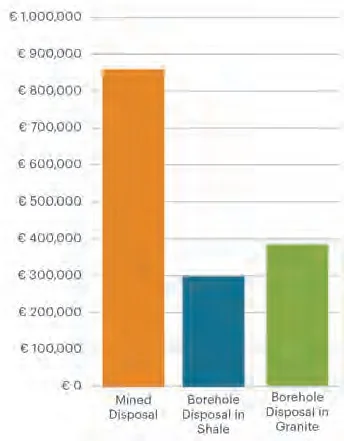
Deep Isolation conducted a Foundation Study for a consortium of countries in Europe and found that disposing of nuclear waste in a deep horizontal borehole repository would be one-third to one-half of the expected cost of a mined deep geological repository.
Challenges and Objectives
Scientific global consensus concludes that the only safe solution for the long-term disposal of high-level radioactive waste is through deep geological disposal. A handful of countries have sophisticated and realistic plans for mined geological repositories; only Finland expects to have an operational facility in the next decade. The largest challenge hampering the progress of deep geological disposal is its cost.
In 2021, Norwegian Nuclear Decommissioning (NND) led a project within ERDO to assess the suitability of deep borehole disposal as an alternative to mined repositories. Their research found that a deep borehole repository is technically feasible, can broaden the range of potentially suitable disposal sites, and has lower fixed costs with greater flexibility compared to mined repositories. NND commissioned a Foundation Study with Deep Isolation to assess specific feasibility and cost scenarios of deploying Deep Isolation’s technology for ERDO’s high-heat generating waste.
Methodology
This project reviewed the radioactive waste inventories of five countries participating in the ERDO borehole project: Croatia, Denmark, the Netherlands, Norway, and Slovenia. Deep Isolation reviewed the total waste inventory and identified currently commercial feasible waste and potentially commercial feasible waste for deep borehole disposal. The currently commercial waste was evaluated for its ease and readiness for disposal. Due to the preliminary nature of the project, Deep Isolation offered a set of high-level design assumptions and concept of operations; these were used to estimate the size and cost of a consolidated multi-national deep borehole repository for ERDO.
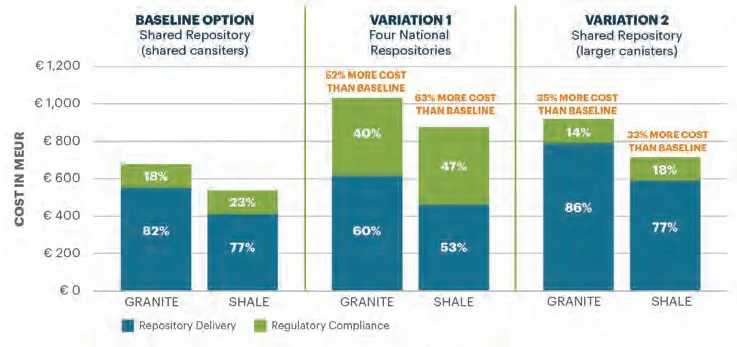
Preliminary ERDO-Wide Analysis of the Cost Impact of Varying Factors


Executive Brief
An initial high-level assessment was conducted of the viability and costs of using Deep Isolation’s deep borehole technology to dispose of radioactive waste from some of the former ERDO Working Group and 2021-established ERDO Association countries. This report was commissioned for Norwegian Nuclear Decommissioning (NND), on behalf of the ERDO Association. Key findings include:
- 100% of the collective inventory of high-level waste is technically and commercially feasible for deep borehole disposal.
- Delivery of a horizontal borehole repository would cost between €418 million and €560 million. Additionally, the costs of regulatory compliance (including site characterization, licensing and post-closure monitoring) might cost a further €124 million.
- This total cost range of €542 – €684 million represents a saving of half to two-thirds of the likely cost of disposal in a mined deep geological repository, based on ERDO’s earlier assessment of such costs.
About NND/ERDO
The ERDO Association countries are comprised of Croatia, Denmark, Italy, the Netherlands, Norway, Poland, and Slovenia. This multi-national working group was established to study the feasibility of one or more shared geological repositories in Europe.
Results
ERDO’s heat generating high-level radioactive waste is well suited for deep borehole disposal. However, ERDO countries will still require one or more mined repositories for its intermediate-level waste and non-heat generating high-level waste which could be co-located with a deep borehole repository. Using co-location could reduce the costs associated with site selection, site characterization, and surface facilities.
Using a deep borehole disposal concept rather than a mined repository for ERDO’s high-heat generating waste could have a cost savings between 55%-65% depending on the host rock of the repository. Other facts that drive this cost variance come from the number of sites, canister sizing, borehole geometry, and rod consolidation.
The high-level waste inventory varies in terms of the boreholes that would be required:
- 59% by volume is suitable for Deep Isolation’s “standard” borehole, which is sized for PWR assemblies in the Croatian and Slovenian SNF inventory
- 30% (all from the Netherlands) will require larger boreholes
- 11% could potentially be disposed of in smaller diameter canisters and boreholes
Based on the assumptions about inventory, canister sizing and borehole configuration, the key physical requirements for an ERDO high-level waste borehole repository are estimated as follows:
- 2,486 standard canisters and 360 large canisters
- 12 standard and 2 large boreholes
- A total sub-surface area of 0.87 km2
- A total surface area of 0.01 km2
Deep borehole disposal of nuclear waste also offers significant benefits including an increase in siting flexibility with an expanded range of suitable locations, phased implementation approach for a shorter initial deployment timeframe, and reduced financial risk as a smaller-scale project with off-the-shelf technologies.

Deep Isolation’s study has been a very helpful input into ERDO’s consideration of deep borehole disposal. It confirms our view that borehole disposal offers a suitable and cost-competitive alternative for spent nuclear fuel, high-level radioactive waste and long-lived low- and intermediate-level radioactive waste for the ERDO countries. The necessary technology is available. The natural next step is a full-scale demonstration of site characterisation, drilling, waste emplacement and borehole sealing, combined with development of a comprehensive safety case.
— Håvard Kristiansen, Sr. Advisor R&D, NND
Disposal Cost per Tonne of Spent Fuel / High-Level Waste
About Deep Isolation
Deep Isolation is a leading innovator in nuclear waste storage and disposal offering a solution that places corrosion-resistant canisters containing spent fuel in deep boreholes 1-5 kilometers underground. These repositories are constructed using directional drilling technology within sedimentary, igneous or metamorphic host rocks – rocks that can be demonstrated to have been isolated from the biosphere for a million years or more. Deep Isolation’s solution offers a practical option backed by:
- Scientific research on the long-term environmental safety performance
- Extensive supply-chain partnerships with leading companies from the global drilling and radioactive waste management sectors
Future Plans
This Foundation Study set out initial high-level assumptions for the conceptual design of a deep borehole repository for all ERDO heat-generating high-level radioactive waste, along with preliminary cost estimates. Further work is needed to develop the detailed roadmap, engineering design, business case and safety case for such a repository.