Universal Canister System (UCS) for Advanced Nuclear Reactor Waste
Deep Isolation and NAC International Inc. have developed the Universal Canister System (UCS) to support advanced reactor development by providing designers with a comprehensive solution for the storage, transportation, and disposal of advanced reactor waste streams.
Preliminary analyses have been performed to ensure the UCS canister meets thermal, volumetric, and criticality waste acceptance constraints for a spectrum of geologic repository options to meet U.S. and international market needs.
The UCS has been designed to satisfy established and anticipated regulatory requirements, including requirements for:
- Storage: US 10 Code of Federal Regulations (CFR) Part 72 and equivalent international IAEA regulations.
- Transportation: US 10 CFR Part 71 and equivalent international IAEA regulations.
- Disposal: Anticipated requirements for disposal in a Mined Geological Repository (MGR) or a Deep Borehole Repository (DBR).
Universal Features of UCS
Designed and Analyzed For:
- Storage
- Transport
- Disposal (Boreholes and Mined Geologic Repositories)
- TRISO (TRi-structural ISOtropic) fuel forms
- Pebbles and compacts (all 3 classes)
- Prismatic blocks (classes 2 and 3)
- Vitrified (glass) waste forms (class 3)
- Molten salt waste forms (all 3 classes)
- SMR fuel assemblies

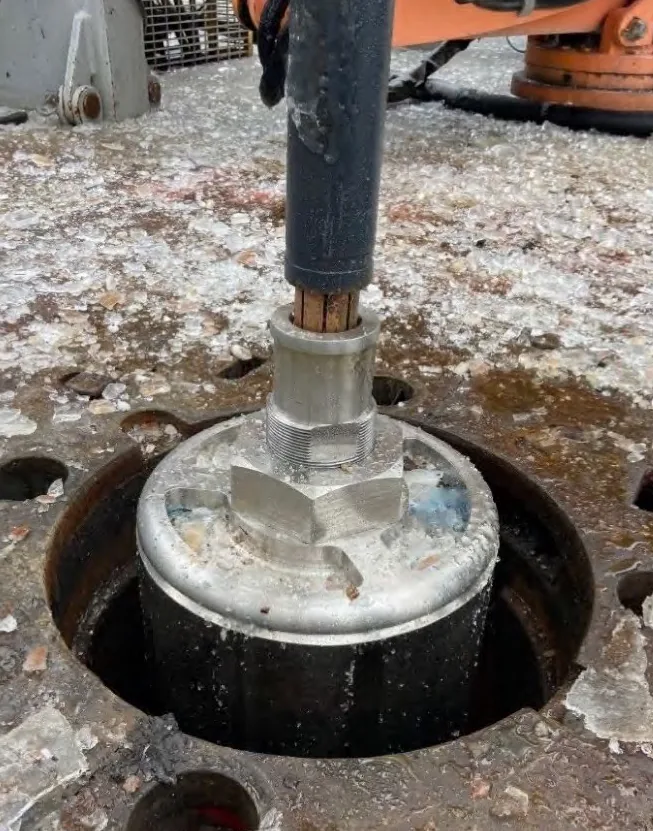
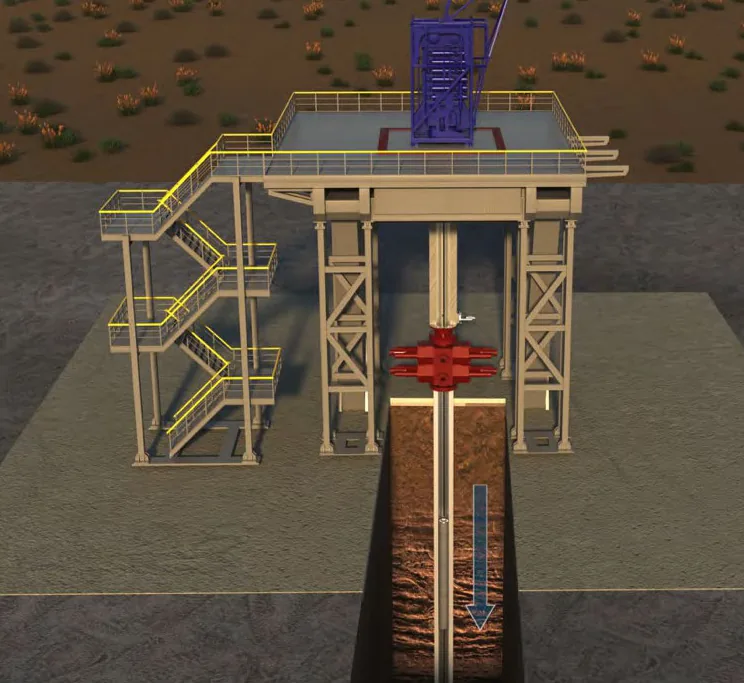
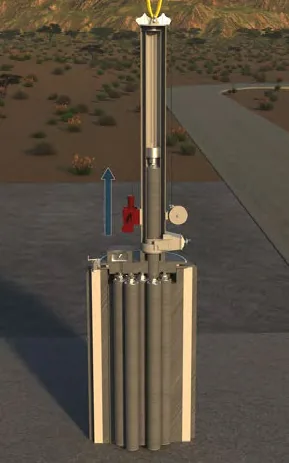
UCS (left); Borehole Demonstration with a Similar Canister (right)
Minimize Repackaging with End-to-End Compatibility
- Operational Flexibility
- Wet or Dry waste loading (in-pool or hot cell environment)
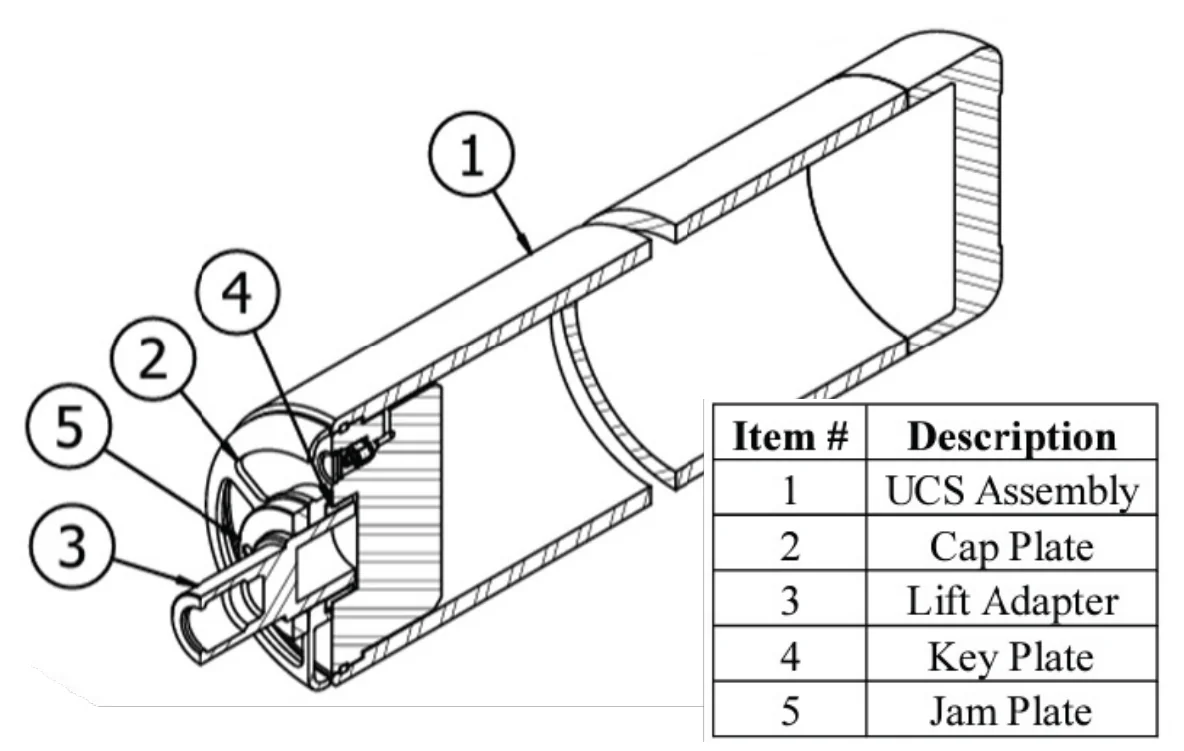
- Lift adapter interface with commercial lifting tools; designed and tested for borehole emplacement and retrieval operations.
- Efficient Storage and Transportation in the NAC MAGNASTOR® and MAGNATRAN® systems
- UCS dimensions compatible with deep boreholes and mined repository disposal configurations
Contact
Jesse Sloane, Deep Isolation Head of Engineering
Phone: +1 410-949-7053 | info@deepisolation.com
Robust Design
- Duplex stainless steel canister design
- Evaluated for structural, thermal, criticality, and shielding performance during limiting normal and off-normal events
- Thick shell to withstand pressures up to 2 km below surface
- Thick lid to minimize occupational dose during loading and disposal operations
Designed for Versatile Applications
The UCS is designed for “Direct Storage to Disposal,” avoiding significant repackaging costs following transport. The UCS Solution enables fewer packaging facilities and opportunities to co-locate a reactor, reprocessing facility, and/or dry storage facility with a repository.
UCS Dimensions, Weights, Expected Contents
| UCS Class | Shell OD | Shell ID | Cavity Length | Total Length | Max Content Weight | Expected Contents |
|---|---|---|---|---|---|---|
| 1 | 14.75” | 12.75” | 170” | 188.5” | 2,000 lbs. | Small Modular Reactor PWR Fuel Assemblies; discharged TRISO compacts and pebbles |
| 2 | 16.75” | 14.50” | 169.5” | 188.5” | 2,500 lbs. | TRISO graphite fuel blocks; molten salt (in containers); TRISO compacts and pebbles |
| 3 | 20.25” | 17.50” | 169” | 188.5” | 4,000 lbs. | Vitrified waste (packaged in secondary canisters [e.g., Sellafield and La Hague type]) |
UCS Capacity (Quantity) of Advanced Reactor Waste Forms
| Waste Form | Class 1 | Class 2 | Class 3 |
|---|---|---|---|
| Vitrified Waste Containers | 0 | 0 | 3 |
| TRISO Prismatic Blocks | 0 | 6 | 6 |
| TRISO Compacts | 162 | 198 | 216 |
UCS Components