
Precious Metals & Critical Minerals Virtual Investor Conference, October 14, 2026
Category: Featured – below subnav on landing
Press Release, October 14, 2026
Nuclear Waste Innovator Deep Isolation Publishes New Slovenian Customer Case Study
Slovenia’s national radioactive waste management agency highlights the potential cost and operational benefits of Deep Isolation’s disposal approach
PLANO, TX – Deep Isolation Nuclear, Inc. (OTCQB: DBHL) (“Deep Isolation” or the “Company”), a leading innovator in nuclear waste disposal technology, today announced the publication of a new customer case study featuring Slovenia’s Agency for Radioactive Waste Management (ARAO). The case study highlights Deep Isolation’s work supporting Slovenia’s long-term nuclear waste disposal planning and features customer insights into the potential economic and operational benefits of its deep borehole disposal technology.
The case study showcases Deep Isolation’s engagement with ARAO to evaluate disposal options for spent nuclear fuel from Slovenia’s TRIGA II research reactor. The collaboration builds on previous assessments conducted by Deep Isolation and reflects growing international interest in flexible, cost-effective approaches to managing nuclear waste inventories.
“The nuclear waste disposal options study gave us a clear comparison of disposal pathways for TRIGA II spent nuclear fuel. It showed that integrating a small inventory into a repository for the Krško SNF can be done with minimal additional cost, without introducing significant safety or scheduling impacts,” said Sandi Viršek, CEO of ARAO.
Deep Isolation’s featured assessment evaluated the potential to integrate TRIGA II spent fuel into a proposed deep borehole repository for Slovenia’s Krško Nuclear Power Plant, compared with developing a dedicated standalone facility. The analysis found that integrating the smaller inventory could potentially increase total repository lifecycle costs by less than approximately 0.5%, highlighting the potential economic advantages of shared disposal infrastructure.
“This case study illustrates how our technology and technical expertise can support countries as they evaluate practical, economically viable pathways for the long-term management of spent nuclear fuel,” said Chris Parker, Chief Commercialization Officer at Deep Isolation. “We look forward to building on this engagement and supporting other national programs facing similar challenges.”
Read the customer case study.
About Deep Isolation
Deep Isolation (OTCQB: DBHL) is the first company to undertake development of technologies for nuclear waste disposal in deep boreholes. Deep Isolation’s solution will offer a unique approach to help countries identify, plan for and complete the necessary steps to dispose of their nuclear waste inventories. With over 100 patents issued to date, Deep Isolation’s technology is designed to leverage proven drilling practices to allow safe isolation of waste deep underground in horizontal, vertical, or slanted borehole repositories. Deep Isolation’s Universal Canister System is engineered to support integrated management of spent fuel and high-level radioactive waste from legacy and advanced reactors across storage, transportation, and eventual disposal. In January 2026, Deep Isolation launched a full-scale, at-depth deep borehole Commercialization Pilot for its solution at Cameron, Texas, in collaboration with the Deep Borehole Demonstration Center, Halliburton (NYSE: HAL), Amentum (NYSE: AMTM), NAC International (TYO: 7004), and Occlusion Nuclear Solutions.
For more information, visit: deepisolation.com.
###
Media Contact:
Sophie McCallum
media@deepisolation.com
Investor Contact:
Caldwell Bailey
InvestorRelations@deepisolation.com
Forward-Looking Statements
Statements contained in this news release that are not historical facts are “forward-looking information” or “forward-looking statements” (collectively, “forward-looking statements”) within the meaning of Section 27A of the Securities Act and Section 21E of the Securities Exchange Act of 1934, as amended. Forward-looking statements include, but are not limited to, statements regarding our plans, objectives and expectations for our business, the future growth of our business and the nuclear energy and nuclear waste disposal industries as a whole, and future benefits expected to arise from our strategic partnerships. In certain cases, forward-looking statements can be identified by the use of words and phrases or variations of words and phrases or statements such as “may,” “should,” “expect,” “intend,” “plan,” “anticipate,” “believe,” “estimate,” “predict,” “will,” “could,” “project,” “target,” “potential,” “continue” and similar expressions. Forward-looking statements are based on management’s belief and assumptions, including current expectations and projections about future events and trends, and on information currently available to management.
Forward-looking statements in this or any other news release are subject to a number of risks, uncertainties, and assumptions that could cause actual results to be materially different from those expressed or implied by such forward-looking statements. Such risks, uncertainties, and assumptions are subject to a number of factors, including, among others: the failure of a market to develop for our deep borehole disposal solutions as quickly as we expect or at all; a failure of demand for our solution to develop sufficiently; regulatory and legal developments, including issues relating to obtaining regulatory approvals or permissions on the timelines we expect or at all; our lack of profitability; delays or failure in our initiative to complete a full-scale, at-depth demonstration of our Universal Canister System and our deep borehole solution; our failure to enter into contracts with customers or, once we do enter into contracts, to continue such contractual relationships or to receive new contract awards; our dependency on governmental contracts and awards and our ability to finalize negotiations on same; our failure to manage our growth effectively or to execute our business plan; our failure to sustain and expand relationships with governmental entities and strategic partners; a failure in the assumptions or analyses we have used in supporting forecasts or plans; our inability to commercialize our products at scale; the development or deployment of other technologies or solutions supplanting or competing with our technologies; challenges to our intellectual property; failures to protect, maintain, enforce, and enhance our intellectual property, and claims by others of intellectual property infringement; political and public perceptions of nuclear energy, including perceptions as to accidents or other high-profile events involving nuclear power facilities or radioactive materials; our liquidity and ability to raise capital; any inability to control operating and project costs and project delays or other project-related problems; security (including cybersecurity) breaches or disruptions; geopolitical, macroeconomic, domestic events or crises, including supply chain disruptions and other risks and uncertainties outside of our control; weather and effects of climate change; and litigation or legal proceedings that may be brought against us.
The foregoing is not an exhaustive list of all the factors that may cause any forward-looking statements to prove inaccurate or our actual results to differ materially from our expectations and forecasts. Moreover, we operate in a highly regulated environment. New risks emerge from time to time. It is not possible for our management to predict all risks, nor can we assess the impact of all factors on our business or the extent to which any factor, or combination of factors, may cause actual results to differ materially from those contained in any forward-looking statements we may make. In light of these risks, uncertainties, and assumptions, the future events and trends discussed in this release may not occur and actual results could differ materially and adversely from those anticipated or implied in the forward-looking statements, and we cannot guarantee future results, performance, or achievements. Accordingly, readers should not place undue reliance on forward-looking statements. We undertake no obligation to update any forward-looking statements for any reason after the date of this release or to conform these statements to actual results or revised expectations, except as required by law.
Additional information concerning the factors above and other factors will be found in the Company’s public filings with the Securities and Exchange Commission (the “SEC”), including the sections titled “Forward-Looking Statements” and “Risk Factors” in the Company’s Reports on Form 10-K and 10-Q for the fiscal year ended December 31, 2025 and the quarter ending March 31, 2026, respectively, as filed with the SEC on March 30, 2026, our Form S-1, originally filed August 18, 2025 and subsequently amended, our Proxy Statement for our 2026 Annual Meeting as filed on April 29, 2026, and in filings with the SEC that will be made in the future. The Company’s SEC filings are available free of charge at www.sec.gov or upon written request to Deep Isolation at InvestorRelations@deepisolation.com or CorpSec@deepisolation.com.
###
Double Take Podcast, October 13, 2026
Solving Nuclear Waste
Global Markets Forum, October 8, 2026
OTCQB Small Cap Conference presentation
Event, November 12, 2026 in Houston, TX
US Energy Risk Summit
Transcript coming soon.
Press Release, October 7, 2026
Nuclear Waste Innovator Deep Isolation to Present at Three Upcoming Investor Conferences
PLANO, TX – Deep Isolation Nuclear, Inc. (OTCQB: DBHL) (“Deep Isolation” or the “Company”), a leading innovator in nuclear waste disposal technology, today announced that CEO Rod Baltzer and CFO Joe Nelson will present at three upcoming investor conferences, offering investors opportunities to learn more about the Company’s technology, commercialization strategy and progress toward deploying deep borehole disposal for nuclear waste.
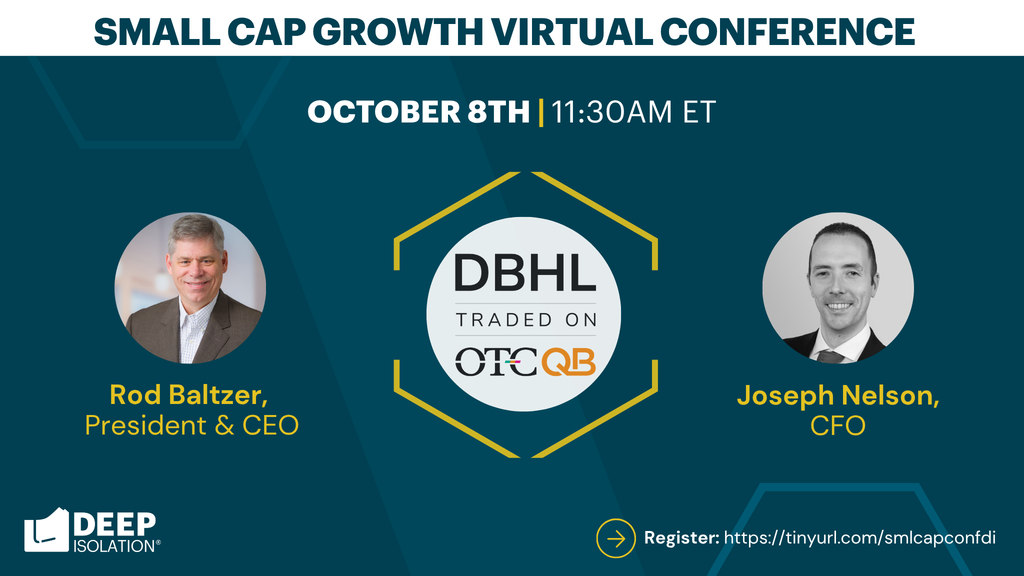
On Oct. 8 at 11.30 am ET, Baltzer and Nelson will participate in the Small Cap Growth Virtual Conference by OTC Markets, an online investor event designed to connect publicly traded companies directly with individual and institutional investors, advisers and analysts. The live, interactive format will provide investors an opportunity to hear from Company leadership and submit questions in real time. Baltzer and Nelson will also be available for 1×1 meetings with investors and analysts. Link to the conference: Registration.
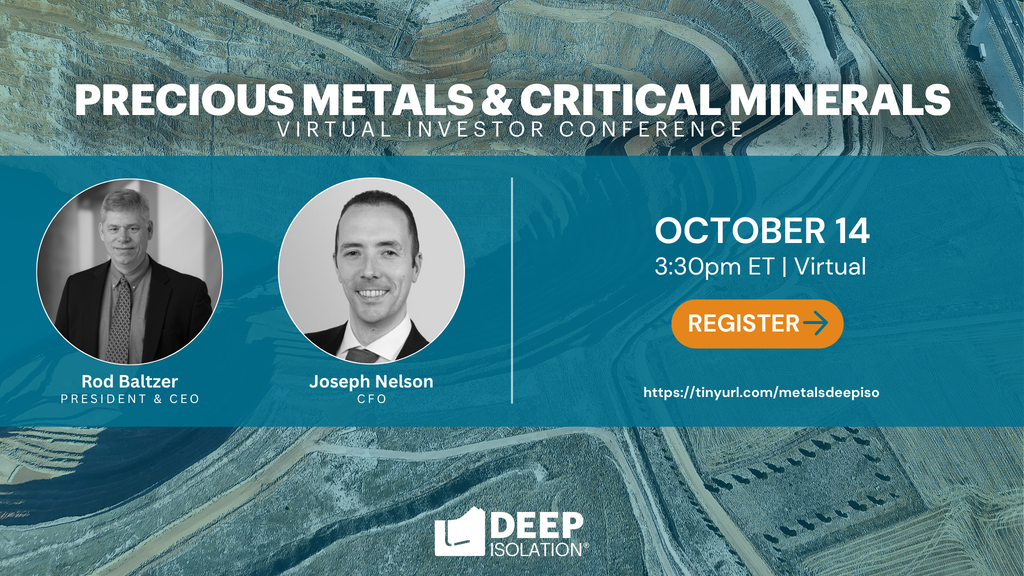
On Oct. 14 at 3:30 pm ET, Deep Isolation will present at the Precious Metals & Critical Minerals Virtual Conference, also hosted by OTC Markets. Baltzer and Nelson will discuss Deep Isolation’s approach to nuclear waste disposal and the Company’s role in supporting the infrastructure needed for the continued development and deployment of nuclear energy. Investors attending virtually will have an opportunity to hear the presentation and engage with Company leadership in 1×1 meetings. Link to the conference: Registration.
On Oct. 15, Baltzer and Nelson will present in person at the ThinkEquity Conference 2026 in New York, where Deep Isolation plans to engage with investors and discuss the Company’s commercialization activities, technology portfolio and opportunities arising from growing investment in nuclear energy and its supporting infrastructure.

“These conferences provide important opportunities to engage directly with the investment community as Deep Isolation advances toward commercialization,” said Baltzer. “We are looking forward to sharing our progress, discussing the growing need for practical nuclear waste disposal solutions and outlining how we are working to make deep borehole disposal an important part of the nuclear industry’s future.”
About Deep Isolation
Deep Isolation (OTCQB: DBHL) is the first company to undertake development of technologies for nuclear waste disposal in deep boreholes. Deep Isolation’s solution will offer a unique approach to help countries identify, plan for and complete the necessary steps to dispose of their nuclear waste inventories. With over 100 patents issued to date, Deep Isolation’s technology is designed to leverage proven drilling practices to allow safe isolation of waste deep underground in horizontal, vertical, or slanted borehole repositories. Deep Isolation’s Universal Canister System is engineered to support integrated management of spent fuel and high-level radioactive waste from legacy and advanced reactors across storage, transportation, and eventual disposal. In January 2026, Deep Isolation launched a full-scale, at-depth deep borehole Commercialization Pilot for its solution at Cameron, Texas, in collaboration with the Deep Borehole Demonstration Center, Halliburton (NYSE: HAL), Amentum (NYSE: AMTM), NAC International (TYO: 7004), and Occlusion Nuclear Solutions.
For more information, visit: deepisolation.com.
###
Media Contact:
Sophie McCallum
media@deepisolation.com
Investor Contact:
Caldwell Bailey
InvestorRelations@deepisolation.com
Forward-Looking Statements
Statements contained in this news release that are not historical facts are “forward-looking information” or “forward-looking statements” (collectively, “forward-looking statements”) within the meaning of Section 27A of the Securities Act and Section 21E of the Securities Exchange Act of 1934, as amended. Forward-looking statements include, but are not limited to, statements regarding our plans, objectives and expectations for our business, the future growth of our business and the nuclear energy and nuclear waste disposal industries as a whole, and future benefits expected to arise from our strategic partnerships. In certain cases, forward-looking statements can be identified by the use of words and phrases or variations of words and phrases or statements such as “may,” “should,” “expect,” “intend,” “plan,” “anticipate,” “believe,” “estimate,” “predict,” “will,” “could,” “project,” “target,” “potential,” “continue” and similar expressions. Forward-looking statements are based on management’s belief and assumptions, including current expectations and projections about future events and trends, and on information currently available to management.
Forward-looking statements in this or any other news release are subject to a number of risks, uncertainties, and assumptions that could cause actual results to be materially different from those expressed or implied by such forward-looking statements. Such risks, uncertainties, and assumptions are subject to a number of factors, including, among others: the failure of a market to develop for our deep borehole disposal solutions as quickly as we expect or at all; a failure of demand for our solution to develop sufficiently; regulatory and legal developments, including issues relating to obtaining regulatory approvals or permissions on the timelines we expect or at all; our lack of profitability; delays or failure in our initiative to complete a full-scale, at-depth demonstration of our Universal Canister System and our deep borehole solution; our failure to enter into contracts with customers or, once we do enter into contracts, to continue such contractual relationships or to receive new contract awards; our dependency on governmental contracts and awards and our ability to finalize negotiations on same; our failure to manage our growth effectively or to execute our business plan; our failure to sustain and expand relationships with governmental entities and strategic partners; a failure in the assumptions or analyses we have used in supporting forecasts or plans; our inability to commercialize our products at scale; the development or deployment of other technologies or solutions supplanting or competing with our technologies; challenges to our intellectual property; failures to protect, maintain, enforce, and enhance our intellectual property, and claims by others of intellectual property infringement; political and public perceptions of nuclear energy, including perceptions as to accidents or other high-profile events involving nuclear power facilities or radioactive materials; our liquidity and ability to raise capital; any inability to control operating and project costs and project delays or other project-related problems; security (including cybersecurity) breaches or disruptions; geopolitical, macroeconomic, domestic events or crises, including supply chain disruptions and other risks and uncertainties outside of our control; weather and effects of climate change; and litigation or legal proceedings that may be brought against us.
The foregoing is not an exhaustive list of all the factors that may cause any forward-looking statements to prove inaccurate or our actual results to differ materially from our expectations and forecasts. Moreover, we operate in a highly regulated environment. New risks emerge from time to time. It is not possible for our management to predict all risks, nor can we assess the impact of all factors on our business or the extent to which any factor, or combination of factors, may cause actual results to differ materially from those contained in any forward-looking statements we may make. In light of these risks, uncertainties, and assumptions, the future events and trends discussed in this release may not occur and actual results could differ materially and adversely from those anticipated or implied in the forward-looking statements, and we cannot guarantee future results, performance, or achievements. Accordingly, readers should not place undue reliance on forward-looking statements. We undertake no obligation to update any forward-looking statements for any reason after the date of this release or to conform these statements to actual results or revised expectations, except as required by law.
Additional information concerning the factors above and other factors will be found in the Company’s public filings with the Securities and Exchange Commission (the “SEC”), including the sections titled “Forward-Looking Statements” and “Risk Factors” in the Company’s Reports on Form 10-K and 10-Q for the fiscal year ended December 31, 2025 and the quarter ending March 31, 2026, respectively, as filed with the SEC on March 30, 2026, our Form S-1, originally filed August 18, 2025 and subsequently amended, our Proxy Statement for our 2026 Annual Meeting as filed on April 29, 2026, and in filings with the SEC that will be made in the future. The Company’s SEC filings are available free of charge at www.sec.gov or upon written request to Deep Isolation at InvestorRelations@deepisolation.com or CorpSec@deepisolation.com.
###
The Lawton Constitution, October 5, 2026
Underground ‘isolation’ being tested for disposal of nuclear waste
U.S.-based Deep Isolation, in partnership with Tulsa-based Occlusion Nuclear Solutions, has launched a multi-year, full-scale, at-depth, deep borehole nuclear waste storage and disposal demonstration program.
Interesting Engineering, October 1, 2026
Texas clears full-scale drilling test to bury spent nuclear fuel deep underground
A Texas drilling permit clears the way for a full-scale test of deep borehole technology designed for nuclear waste disposal.
Press Release, October 1, 2026
Deep Isolation Advances Nuclear Waste Disposal Demonstration with Issuance of Texas Drilling Permit
Regulatory Authorization Supports Deep Isolation’s Plans to Move Its Full-Scale, Non-Radioactive Commercialization Pilot Toward Construction and Field Activities
BERKELEY, CA – Deep Isolation Nuclear, Inc. (OTCQB: DBHL) (“Deep Isolation” or the “Company”), a leading innovator in nuclear waste disposal technology, today announced that the Texas Railroad Commission has issued a drilling permit for the Company’s full-scale, non-radioactive Commercialization Pilot near Cameron, Texas. The regulatory authorization allows the project to advance from engineering and design toward construction and field activities at the demonstration site.
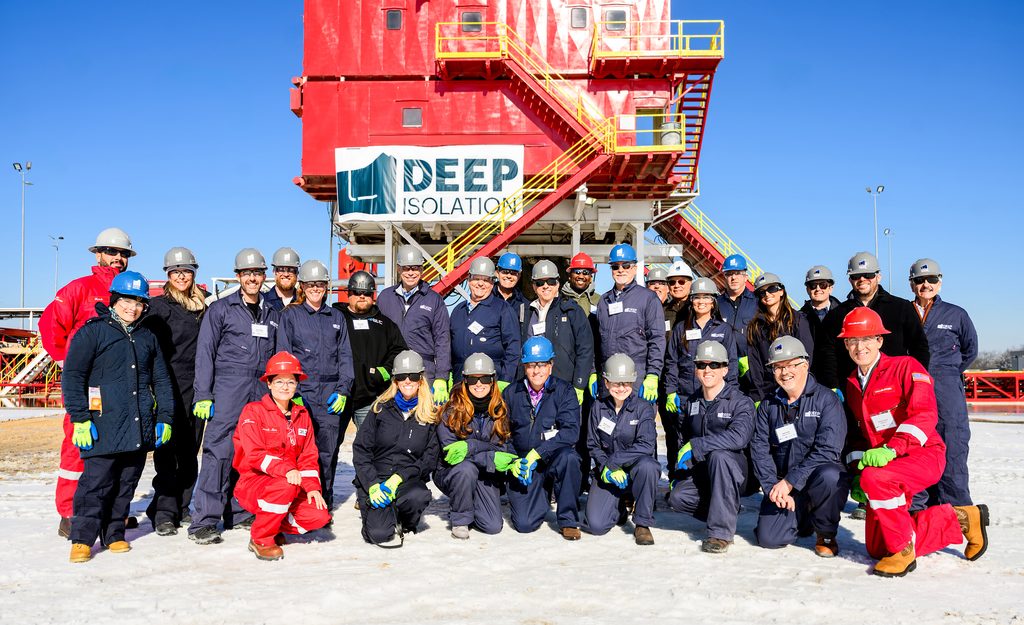
“Receipt of this permit is a major milestone for Deep Isolation as we move the development of our deep borehole disposal technology into field activities,” said Jesse Sloane, Executive Vice President of Engineering at Deep Isolation. “The Commercialization Pilot is designed to demonstrate, at full scale and at depth, the integrated technologies and operations that underpin our deep borehole disposal solution. Reaching this point reflects a tremendous amount of rigorous, high-quality work by our team and our project collaborators. We are incredibly excited to move into the construction and field work phase together with these collaborators and bring years of engineering and planning into the field.”
“This milestone demonstrates the technical design, project preparation, and collaboration behind the Commercialization Pilot,” said Steve Haden, Senior Vice President, Project Management, at Halliburton. “As we drill a new well for this effort, Halliburton will apply its subsurface, drilling, and well construction experience to support the deployment of Deep Isolation’s technology in a new application and assist the project team.”
The Commercialization Pilot is designed as a full-scale, end-to-end demonstration of Deep Isolation’s deep borehole disposal technology using non-radioactive materials. The project aims to demonstrate key operational activities associated with the Company’s solution, providing field data and operational experience intended to support future commercial deployment.
The Texas project brings together Deep Isolation with the Deep Borehole Demonstration Center, Halliburton (NYSE: HAL), Amentum (NYSE: AMTM), NAC International (TYO: 7004), and Occlusion Nuclear Solutions. With the drilling permit issued, the project team plans to advance site and construction activities in preparation for subsequent drilling and subsurface testing.
The drilling permit represents another step toward demonstrating how proven drilling practices can be adapted for deep borehole disposal of spent nuclear fuel and high-level radioactive waste. By demonstrating its system at full scale without radioactive material, Deep Isolation aims to generate practical engineering and operational experience that can inform future commercial projects.
About Deep Isolation
Deep Isolation (OTCQB: DBHL) is the first company to undertake development of technologies for nuclear waste disposal in deep boreholes. When commercialized, Deep Isolation’s solution will offer a unique approach to help countries identify, plan for and complete the necessary steps to dispose of their nuclear waste inventories. With over 100 patents issued to date, Deep Isolation’s technology is being designed to leverage proven drilling practices to allow safe isolation of waste deep underground in horizontal, vertical, or slanted borehole repositories. Deep Isolation’s Universal Canister System was developed through a three-year project funded by the U.S. Department of Energy’s Advanced Research Projects Agency–Energy and is engineered to support integrated management of spent fuel and high-level radioactive waste from legacy and advanced reactors across storage, transportation, and eventual disposal. In January 2026, Deep Isolation launched a full-scale, at-depth deep borehole Commercialization Pilot for its solution at Cameron, Texas, in collaboration with the Deep Borehole Demonstration Center, Halliburton (NYSE: HAL), Amentum (NYSE: AMTM), NAC International (TYO: 7004), and Occlusion Nuclear Solutions.
For more information, visit: deepisolation.com.
###
Media Contact:
Sophie McCallum
media@deepisolation.com
Investor Contact:
Caldwell Bailey
InvestorRelations@deepisolation.com
Forward-Looking Statements
Statements contained in this news release that are not historical facts are “forward-looking information” or “forward-looking statements” (collectively, “forward-looking statements”) within the meaning of Section 27A of the Securities Act and Section 21E of the Securities Exchange Act of 1934, as amended. Forward-looking statements include, but are not limited to, statements regarding our plans, objectives and expectations for our business, the future growth of our business and the nuclear energy and nuclear waste disposal industries as a whole, and future benefits expected to arise from our strategic partnerships. In certain cases, forward-looking statements can be identified by the use of words and phrases or variations of words and phrases or statements such as “may,” “should,” “expect,” “intend,” “plan,” “anticipate,” “believe,” “estimate,” “predict,” “will,” “could,” “project,” “target,” “potential,” “continue” and similar expressions. Forward-looking statements are based on management’s belief and assumptions, including current expectations and projections about future events and trends, and on information currently available to management.
Forward-looking statements in this or any other news release are subject to a number of risks, uncertainties, and assumptions that could cause actual results to be materially different from those expressed or implied by such forward-looking statements. Such risks, uncertainties, and assumptions are subject to a number of factors, including, among others: the failure of a market to develop for our deep borehole disposal solutions as quickly as we expect or at all; a failure of demand for our solution to develop sufficiently; regulatory and legal developments, including issues relating to obtaining regulatory approvals or permissions on the timelines we expect or at all; our lack of profitability; delays or failure in our initiative to complete a full-scale, at-depth demonstration of our Universal Canister System and our deep borehole solution; our failure to enter into contracts with customers or, once we do enter into contracts, to continue such contractual relationships or to receive new contract awards; our dependency on governmental contracts and awards and our ability to finalize negotiations on same; our failure to manage our growth effectively or to execute our business plan; our failure to sustain and expand relationships with governmental entities and strategic partners; a failure in the assumptions or analyses we have used in supporting forecasts or plans; our inability to commercialize our products at scale; the development or deployment of other technologies or solutions supplanting or competing with our technologies; challenges to our intellectual property; failures to protect, maintain, enforce, and enhance our intellectual property, and claims by others of intellectual property infringement; political and public perceptions of nuclear energy, including perceptions as to accidents or other high-profile events involving nuclear power facilities or radioactive materials; our liquidity and ability to raise capital; any inability to control operating and project costs and project delays or other project-related problems; security (including cybersecurity) breaches or disruptions; geopolitical, macroeconomic, domestic events or crises, including supply chain disruptions and other risks and uncertainties outside of our control; weather and effects of climate change; and litigation or legal proceedings that may be brought against us.
The foregoing is not an exhaustive list of all the factors that may cause any forward-looking statements to prove inaccurate or our actual results to differ materially from our expectations and forecasts. Moreover, we operate in a highly regulated environment. New risks emerge from time to time. It is not possible for our management to predict all risks, nor can we assess the impact of all factors on our business or the extent to which any factor, or combination of factors, may cause actual results to differ materially from those contained in any forward-looking statements we may make. In light of these risks, uncertainties, and assumptions, the future events and trends discussed in this release may not occur and actual results could differ materially and adversely from those anticipated or implied in the forward-looking statements, and we cannot guarantee future results, performance, or achievements. Accordingly, readers should not place undue reliance on forward-looking statements. We undertake no obligation to update any forward-looking statements for any reason after the date of this release or to conform these statements to actual results or revised expectations, except as required by law.
Additional information concerning the factors above and other factors will be found in the Company’s public filings with the Securities and Exchange Commission (the “SEC”), including the sections titled “Forward-Looking Statements” and “Risk Factors” in the Company’s Reports on Form 10-K and 10-Q for the fiscal year ended December 31, 2025 and the quarter ending March 31, 2026, respectively, as filed with the SEC on March 30, 2026, our Form S-1, originally filed August 18, 2025 and subsequently amended, our Proxy Statement for our 2026 Annual Meeting as filed on April 29, 2026, and in filings with the SEC that will be made in the future. The Company’s SEC filings are available free of charge at www.sec.gov or upon written request to Deep Isolation at InvestorRelations@deepisolation.com or CorpSec@deepisolation.com.
###
KJRH -TV, September 30, 2026