Deep Isolation’s Jesse Sloane will join the inaugural Mines Nuclear Energy Symposium: “Colorado’s Nuclear Future” on November 12, 2026, at the Colorado School of Mines in Golden, Colorado. Jesse will participate in the panel “Closing the Loop: Recycling and Waste Management in the U.S. Fuel Cycle,” discussing nuclear fuel recycling, waste management, and the role of deep borehole disposal in safely managing high-level nuclear waste.
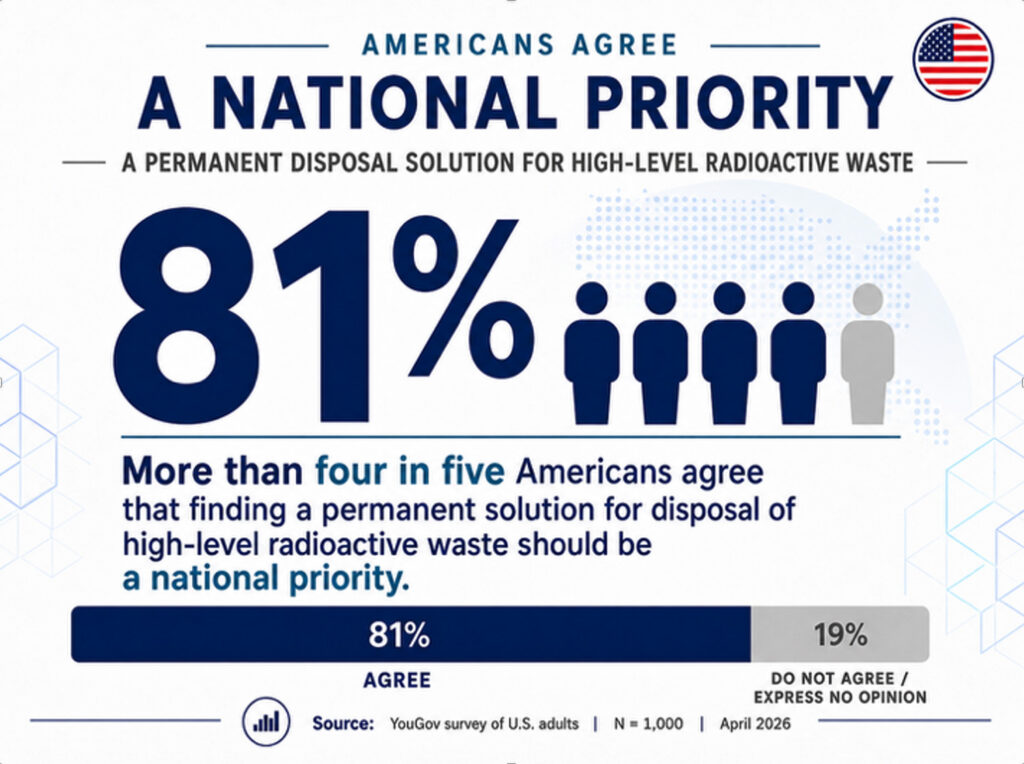
A new nationally representative survey conducted by YouGov at the request of Deep Isolation Nuclear, Inc. high-lights a growing consensus among the American public re-garding the back-end of the nuclear fuel cycle. According to survey results, 81% of respondents believe that securing a permanent high-level radioactive waste disposal solution should be a national priority.
Deep Isolation Nuclear CEO Rod Baltzer joined Steve Darling from Proactive to explain how the company is adapting directional drilling technology from the oil and gas industry to dispose of spent nuclear fuel in boreholes drilled roughly one mile underground.
Over 80% of US citizens think finding a permanent solution for the disposal of high-level radioactive waste should be a US priority – and many see deep geological disposal a credible solution, according to a survey by market research and data analytics firm YouGov.
YouGov Research Commissioned by Deep Isolation Finds Americans Want a Permanent Nuclear Waste Plan, Trust Experts to Guide Decision-Making, and Favor Deep Geologic Disposal
BERKELEY, CA – Deep Isolation Nuclear, Inc. (OTCQB: DBHL) (“Deep Isolation” or the “Company”), a leading innovator in nuclear waste disposal technology, today released the results of a nationally representative U.S. survey conducted by YouGov that found 81% of Americans believe finding a permanent solution for disposal of high-level radioactive waste should be a national priority. By contrast, only 28% supported continuing to store used nuclear fuel at reactor sites for many decades. The research also found strong support for deep geologic disposal, broad trust in scientists and engineers to help guide waste management decisions, and continued support for nuclear energy in the United States.
The survey, conducted in April 2026 among 1,000 U.S. adults, found that 61% of respondents support the continued use of nuclear power in the United States. It also found that 74% of respondents support underground disposal approaches that reduce the need to transport used nuclear fuel and high-level radioactive waste over long distances. After respondents reviewed factual information about geologic disposal technologies, 65% supported deep borehole disposal as a solution for managing high-level radioactive waste. Read the full report here.
The survey findings carry important implications for U.S. energy and waste management policy. As policymakers consider the future of nuclear energy, the results suggest strong public support for moving beyond indefinite storage and advancing a permanent strategy for managing used nuclear fuel and high-level radioactive waste. The findings also indicate that public confidence is likely to depend on transparent decision-making, meaningful public engagement and the visible involvement of trusted scientific and engineering experts.
“This research comes at an important time as policymakers and industry leaders work to advance a long-term strategy for managing spent nuclear fuel,” Todd Abrajano, President and CEO of the U.S. Nuclear Industry Council (USNIC), said. “The strong public support reflected in this survey aligns with growing interest in state-led approaches, including the Nuclear Lifecycle Innovation Campus initiative, that combine innovation with durable waste management solutions. As the U.S. looks to expand nuclear energy to meet rising electricity demand, we must pursue practical, science-based pathways that address the back end of the fuel cycle. Deep Isolation’s findings show Americans recognize the importance of advancing long-term waste management solutions to support the next generation of nuclear energy.”
The survey comes amid renewed attention on nuclear energy as a source of reliable, low-carbon electricity. While support for nuclear energy was broadly positive, 69% of respondents expressed concern that the United States still lacks a permanent solution for high-level radioactive waste disposal, underscoring the importance of addressing the back end of the nuclear fuel cycle as part of the nation’s energy future. The survey also revealed a significant trust gap between technical experts and government institutions. 68% of respondents said they trust scientists and engineers to help government select the best waste management solution, compared with 37% who expressed trust in government alone to make sound nuclear energy policy decisions.
“The results of the YouGov survey demonstrate that Americans recognize the importance of addressing the nuclear waste challenge and are looking for practical, science-based solutions to permanent waste disposal,” said Chris Parker, Chief Commercialization Officer at Deep Isolation. “The survey also reinforces that transparent communication and trusted technical expertise play a critical role in building public confidence as the United States evaluates long-term disposal options.”
About Deep Isolation
Deep Isolation (OTCQB: DBHL) is the first company to undertake development of technologies for nuclear waste disposal in deep boreholes. When commercialized, Deep Isolation’s solution will offer a unique approach to help countries identify, plan for and complete the necessary steps to dispose of their nuclear waste inventories. With over 100 patents issued to date, Deep Isolation’s technology is being designed to leverage proven drilling practices to allow safe isolation of waste deep underground in horizontal, vertical, or slanted borehole repositories. Deep Isolation’s Universal Canister System was developed through a three-year project funded by the U.S. Department of Energy’s Advanced Research Projects Agency–Energy and is engineered to support integrated management of spent fuel and high-level radioactive waste from legacy and advanced reactors across storage, transportation, and eventual disposal. In January 2026, Deep Isolation launched a full-scale, at-depth deep borehole Commercialization Pilot for its solution at Cameron, Texas, in collaboration with the Deep Borehole Demonstration Center, Halliburton (NYSE: HAL), Amentum (NYSE: AMTM), NAC International, and Occlusion Nuclear Solutions.
Statements contained in this news release that are not historical facts are “forward-looking information” or “forward-looking statements” (collectively, “forward-looking statements”) within the meaning of Section 27A of the Securities Act and Section 21E of the Securities Exchange Act of 1934, as amended. Forward-looking statements include, but are not limited to, statements regarding our plans, objectives and expectations for our business, the future growth of our business and the nuclear energy and nuclear waste disposal industries as a whole, and future benefits expected to arise from our strategic partnerships. In certain cases, forward-looking statements can be identified by the use of words and phrases or variations of words and phrases or statements such as “may,” “should,” “expect,” “intend,” “plan,” “anticipate,” “believe,” “estimate,” “predict,” “will,” “could,” “project,” “target,” “potential,” “continue” and similar expressions. Forward-looking statements are based on management’s belief and assumptions, including current expectations and projections about future events and trends, and on information currently available to management.
Forward-looking statements in this or any other news release are subject to a number of risks, uncertainties, and assumptions that could cause actual results to be materially different from those expressed or implied by such forward-looking statements. Such risks, uncertainties, and assumptions are subject to a number of factors, including, among others: the failure of a market to develop for our deep borehole disposal solutions as quickly as we expect or at all; a failure of demand for our solution to develop sufficiently; regulatory and legal developments, including issues relating to obtaining regulatory approvals or permissions on the timelines we expect or at all; our lack of profitability; delays or failure in our initiative to complete a full-scale, at-depth demonstration of our Universal Canister System and our deep borehole solution; our failure to enter into contracts with customers or, once we do enter into contracts, to continue such contractual relationships or to receive new contract awards; our dependency on governmental contracts and awards and our ability to finalize negotiations on same; our failure to manage our growth effectively or to execute our business plan; our failure to sustain and expand relationships with governmental entities and strategic partners; a failure in the assumptions or analyses we have used in supporting forecasts or plans; our inability to commercialize our products at scale; the development or deployment of other technologies or solutions supplanting or competing with our technologies; challenges to our intellectual property; failures to protect, maintain, enforce, and enhance our intellectual property, and claims by others of intellectual property infringement; political and public perceptions of nuclear energy, including perceptions as to accidents or other high-profile events involving nuclear power facilities or radioactive materials; our liquidity and ability to raise capital; any inability to control operating and project costs and project delays or other project-related problems; security (including cybersecurity) breaches or disruptions; geopolitical, macroeconomic, domestic events or crises, including supply chain disruptions and other risks and uncertainties outside of our control; weather and effects of climate change; and litigation or legal proceedings that may be brought against us.
The foregoing is not an exhaustive list of all the factors that may cause any forward-looking statements to prove inaccurate or our actual results to differ materially from our expectations and forecasts. Moreover, we operate in a highly regulated environment. New risks emerge from time to time. It is not possible for our management to predict all risks, nor can we assess the impact of all factors on our business or the extent to which any factor, or combination of factors, may cause actual results to differ materially from those contained in any forward-looking statements we may make. In light of these risks, uncertainties, and assumptions, the future events and trends discussed in this release may not occur and actual results could differ materially and adversely from those anticipated or implied in the forward-looking statements, and we cannot guarantee future results, performance, or achievements. Accordingly, readers should not place undue reliance on forward-looking statements. We undertake no obligation to update any forward-looking statements for any reason after the date of this release or to conform these statements to actual results or revised expectations, except as required by law.
Additional information concerning the factors above and other factors will be found in the Company’s public filings with the Securities and Exchange Commission (the “SEC”), including the sections titled “Forward-Looking Statements” and “Risk Factors” in the Company’s Reports on Form 10-K and 10-Q for the fiscal year ended December 31, 2025 and the quarter ending March 31, 2026, respectively, as filed with the SEC on March 30, 2026, our Form S-1, originally filed August 18, 2025 and subsequently amended, our Proxy Statement for our 2026 Annual Meeting as filed on April 29, 2026, and in filings with the SEC that will be made in the future. The Company’s SEC filings are available free of charge at www.sec.gov or upon written request to Deep Isolation at InvestorRelations@deepisolation.com or CorpSec@deepisolation.com.
Operational Highlights for the Second Quarter of 2026
The SEC declared Deep Isolation Nuclear, Inc.’s registration statement on Form S-1 effective on May 7, 2026, allowing the common stock of the Company to be freely tradable
Surpassed 100 issued patents worldwide, spanning repository architecture, geologic site characterization, canister and packaging systems, emplacement and retrieval technologies, and repository closure and monitoring
Established a full-time field presence at the Deep Borehole Demonstration Center near Cameron, Texas to lead execution of the Company’s full-scale demonstration program
Subsequent to quarter end, the Company’s common stock began trading on the OTCQB Venture Market under the ticker symbol “DBHL”
Subsequent to quarter end, on July 23, 2026 the Company was selected as the sole industrial partner on three competitive federal grants awarded under the U.S. Department of Energy’s Project GENESIS program
Financial Highlights for the Second Quarter of 2026
Reported consolidated revenue of $1.3 million
Reported research and development expense of approximately $1.2 million related to the non-radioactive, full-scale, at-depth demonstration of our deep borehole waste disposal technology
Had available cash of $19.4 million as of June 30, 2026
Reported a net loss of $3.0 million primarily attributable to research and development and selling, general, and administrative expenses
Total common shares outstanding as of August 3, 2026 of 57,667,113
BERKELEY, CA – Deep Isolation Nuclear, Inc. (OTCQB: DBHL) (“Deep Isolation” or the “Company”), a leading innovator in nuclear waste disposal technology, today announced its operational and financial results for the three-months ended June 30, 2026.
“The second quarter was about converting milestones into execution,” said Rod Baltzer, CEO of Deep Isolation. “We established a permanent field presence at the Deep Borehole Demonstration Center near Cameron, Texas, to lead the world’s first full-scale, at-depth demonstration of deep borehole disposal, and we surpassed 100 issued patents worldwide — a portfolio that now spans the full disposal lifecycle, from geologic site characterization through canister emplacement and repository closure.
“We also took important steps as a public company. The SEC declared our registration statement on Form S-1 effective during the quarter, and shortly after quarter end our common stock began trading on the OTCQB Venture Market under the ticker symbol ‘DBHL.’ We were subsequently selected as the sole industrial partner on three Department of Energy Project GENESIS awards alongside Lawrence Berkeley National Laboratory and the University of South Carolina, deepening our research collaboration with the national laboratory system. These achievements demonstrate our team’s execution capabilities and reinforce Deep Isolation’s leadership in delivering practical solutions for one of the nuclear industry’s most critical challenges. We believe we are entering the market at exactly the right time, as the nuclear industry scales up and the need for a scalable waste disposal solution grows more urgent.”
Operational Progress
Deep Isolation advanced execution of its full-scale, at-depth deep borehole demonstration program at the Deep Borehole Demonstration Center (“DBDC”), located at Halliburton’s Drilling Technology Facility near Cameron, Texas. On June 17, 2026, the Company announced that Technology Demonstration Lead Jon Tedrick had relocated to Texas to establish a permanent field presence as the project moves toward active operations. Conducted via collaboration between the DBDC, Halliburton, Amentum, NAC International, Occlusion Nuclear Solutions and Westinghouse, the non-radioactive demonstration program is designed to demonstrate construction of a deep borehole repository using standard oil and gas drilling practices, full-scale emplacement and retrieval of the Company’s Universal Canister System (“UCS”), and simulated surface handling operations.
On May 27, 2026, the Company announced that it had surpassed 100 issued patents worldwide, spanning repository architecture, geologic site characterization, canister and packaging systems, emplacement and retrieval technologies, and repository closure and monitoring. Deep Isolation also continued to advance through the contracting phase for the U.S. Department of Energy’s (“DOE) Advanced Research Projects Agency-Energy’s (“ARPA-E”) Seeding Critical Advances for Leading Energy technologies with Untapped Potential (“SCALEUP”) Ready program, which, if an award is successfully negotiated, would provide up to $20 million toward full-scale field testing of the UCS at Cameron, Texas; Deep Isolation is the first company in the nuclear industry ever selected to participate in the SCALEUP Ready program.
Commercial Progress and Other Company Events
During the quarter, Deep Isolation completed the remaining steps required to make its common stock publicly tradable. On May 7, 2026, the U.S. Securities and Exchange Commission (“SEC”) declared the Company’s registration statement on Form S-1 effective, allowing the Company’s common stock to be freely tradable. The Company then worked with OTC Markets Group, Inc. on its application to have its shares of common stock quoted on the OTCQB Venture Market.
On July 13, 2026, the Company announced that its application for listing its common stock on the OTCQB Venture Market had been approved, and its common stock is now available to trade under the ticker symbol “DBHL.” On July 15, 2026, Chief Executive Officer Rod Baltzer issued a letter to shareholders marking the Company’s first quotation on the OTCQB and describing its transition from research and development toward commercial readiness. On July 23, 2026, the Company was selected as the sole industrial partner on three U.S. Department of Energy Project GENESIS grants led by Lawrence Berkeley National Laboratory and the University of South Carolina, advancing artificial intelligence-enabled repository site screening, design and performance analysis.
Nuclear Industry Developments
The global nuclear energy industry continued to strengthen during the second quarter of 2026, supported by rising electricity demand, energy security priorities and the need for reliable, carbon-free generation. Governments and utilities continued advancing new reactor development and extending the operating lives of existing nuclear facilities, while growing electricity demand from artificial intelligence, data centers and industrial electrification accelerated corporate interest in nuclear power. Together, these trends reinforced the increasingly important role of nuclear energy in meeting long-term energy needs.
Government policy and financing also remained important catalysts for industry growth. During the quarter, the United States and several international governments advanced financing initiatives, licensing reforms and investment programs designed to accelerate deployment of both conventional and advanced nuclear technologies. Countries across North America and Europe continued expanding long-term nuclear generation plans, reflecting increasing recognition of nuclear energy as a strategic component of energy security and decarbonization efforts. Subsequent to quarter-end, the U.S. Department of Energy announced the first states selected to participate in its Nuclear Lifecycle Innovation Campuses initiative, highlighting continued federal investment in developing an integrated domestic nuclear fuel cycle and long-term spent fuel management infrastructure. This may have the potential to accelerate the need for borehole disposal options in the U.S.
Investment across the nuclear sector remained active throughout the quarter, with continued progress in advanced reactors, nuclear fuel, waste management and supporting infrastructure. In management’s view, these developments reinforce the long-term outlook for nuclear energy and may increase demand for permanent nuclear waste disposal solutions as existing reactor fleets operate longer and new reactors enter service. These industry trends, if they continue, could strengthen the long-term market opportunity for Deep Isolation’s technology and services.
Financial Summary
For the Three Months Ended
For the Three Months Ended
Amounts in thousands
June 30, 2026
June 30, 2025
Revenue
$ 1,319
$ 1,634
Research and development expense
$ 1,180
$ —
Selling, general and administrative expenses
$ 2,746
$ 2,215
Net Loss
$ (3,036)
$ (1,363)
EBITDA1
$ (3,192)
$ (1,337)
Adjusted EBITDA1
$ (1,915)
$ (1,337)
Cash
$ 19,379
$ 1,852
Revenue decreased by approximately $0.3 million, or 19%, for the three months ended June 30, 2026, compared to the three months ended June 30, 2025. The decrease in revenue was primarily attributable to lower revenues at Deep Isolation following the completion of certain projects during 2025.
Research and development expense increased by approximately $1.2 million for the three months ended June 30, 2026, compared to the three months ended June 30, 2025. The increase in research and development expense was attributed to the ordering of long-lead items and front-end engineering work related to the Company’s non-radioactive, full-scale, at-depth demonstration of its DBD technologies.
Selling, General and Administrative expenses increased by approximately $0.5 million, or 24%, for the three months ended June 30, 2026, compared to the three months ended June 30, 2025. The increase in selling, general and administrative expenses was primarily attributable to higher accounting, audit, legal and travel expenses along with addition of 7 new employees since the beginning of 2026, including the Chief Financial Officer and General Counsel.
Net loss increased by $1.7 million for the three months ended June 30, 2026, compared to the three months ended June 30, 2025, primarily due to the increases in research and development and selling, general and administrative expenses described above.
EBITDA1 was (3.2) million for the three months ended June 30, 2026, compared to (1.3) million for the three months ended June 30, 2025. The decrease in EBITDA was primarily attributed to higher research and development expenses and selling, general, and administrative expenses as described above.
Adjusted EBITDA1 was $(1.9) million for the three months ended June 30, 2026, compared to $(1.3) million for the three months ended June 30, 2025. The decrease in Adjusted EBITDA was primarily attributed to higher selling, general, and administrative expenses as described above.
1 EBITDA and Adjusted EBITDA are non-GAAP financial measures and should not be used in isolation or as a substitute for Deep Isolation’s financial results presented in accordance with Generally Accepted Accounting Principles (“GAAP”). For the definitions and reconciliations of these measures to the most directly comparable financial measures calculated and presented in accordance with GAAP, please refer to Exhibit II at the end of this press release.
Deep Isolation (OTCQB: DBHL) is the first company to undertake development of technologies for nuclear waste disposal in deep boreholes. When commercialized, Deep Isolation’s solution will offer a unique approach to help countries identify, plan for and complete the necessary steps to dispose of their nuclear waste inventories. With over 100 patents issued to date, Deep Isolation’s technology is being designed to leverage proven drilling practices to allow safe isolation of waste deep underground in horizontal, vertical, or slanted borehole repositories. Deep Isolation’s Universal Canister System was developed through a three-year project funded by the U.S. Department of Energy’s Advanced Research Projects Agency–Energy and is engineered to support integrated management of spent fuel and high-level radioactive waste from legacy and advanced reactors across storage, transportation, and eventual disposal. In January 2026, Deep Isolation launched a full-scale, at-depth deep borehole Commercialization Pilot for its solution at Cameron, Texas, in collaboration with the Deep Borehole Demonstration Center, Halliburton (NYSE: HAL), Amentum (NYSE: AMTM), NAC International, and Occlusion Nuclear Solutions.
Statements contained in this news release that are not historical facts are “forward-looking information” or “forward-looking statements” (collectively, “forward-looking statements”) within the meaning of Section 27A of the Securities Act and Section 21E of the Securities Exchange Act of 1934, as amended. Forward-looking statements include, but are not limited to, statements regarding our plans, objectives and expectations for our business, the future growth of our business and the nuclear energy and nuclear waste disposal industries as a whole, and future benefits expected to arise from our strategic partnerships. In certain cases, forward-looking statements can be identified by the use of words and phrases or variations of words and phrases or statements such as “may,” “should,” “expect,” “intend,” “plan,” “anticipate,” “believe,” “estimate,” “predict,” “will,” “could,” “project,” “target,” “potential,” “continue” and similar expressions. Forward-looking statements are based on management’s belief and assumptions, including current expectations and projections about future events and trends, and on information currently available to management.
Forward-looking statements in this or any other news release are subject to a number of risks, uncertainties, and assumptions that could cause actual results to be materially different from those expressed or implied by such forward-looking statements. Such risks, uncertainties, and assumptions are subject to a number of factors, including, among others: the failure of a market to develop for our deep borehole disposal solutions as quickly as we expect or at all; a failure of demand for our solution to develop sufficiently; regulatory and legal developments, including issues relating to obtaining regulatory approvals or permissions on the timelines we expect or at all; our lack of profitability; delays or failure in our initiative to complete a full-scale, at-depth demonstration of our Universal Canister System and our deep borehole solution; our failure to enter into contracts with customers or, once we do enter into contracts, to continue such contractual relationships or to receive new contract awards; our dependency on governmental contracts and awards and our ability to finalize negotiations on same; our failure to manage our growth effectively or to execute our business plan; our failure to sustain and expand relationships with governmental entities and strategic partners; a failure in the assumptions or analyses we have used in supporting forecasts or plans; our inability to commercialize our products at scale; the development or deployment of other technologies or solutions supplanting or competing with our technologies; challenges to our intellectual property; failures to protect, maintain, enforce, and enhance our intellectual property, and claims by others of intellectual property infringement; political and public perceptions of nuclear energy, including perceptions as to accidents or other high-profile events involving nuclear power facilities or radioactive materials; our liquidity and ability to raise capital; any inability to control operating and project costs and project delays or other project-related problems; security (including cybersecurity) breaches or disruptions; geopolitical, macroeconomic, domestic events or crises, including supply chain disruptions and other risks and uncertainties outside of our control; weather and effects of climate change; and litigation or legal proceedings that may be brought against us.
The foregoing is not an exhaustive list of all the factors that may cause any forward-looking statements to prove inaccurate or our actual results to differ materially from our expectations and forecasts. Moreover, we operate in a highly regulated environment. New risks emerge from time to time. It is not possible for our management to predict all risks, nor can we assess the impact of all factors on our business or the extent to which any factor, or combination of factors, may cause actual results to differ materially from those contained in any forward-looking statements we may make. In light of these risks, uncertainties, and assumptions, the future events and trends discussed in this release may not occur and actual results could differ materially and adversely from those anticipated or implied in the forward-looking statements, and we cannot guarantee future results, performance, or achievements. Accordingly, readers should not place undue reliance on forward-looking statements. We undertake no obligation to update any forward-looking statements for any reason after the date of this release or to conform these statements to actual results or revised expectations, except as required by law. Additional information concerning the factors above and other factors will be found in the Company’s public filings with the Securities and Exchange Commission (the “SEC”), including the sections titled “Forward-Looking Statements” and “Risk Factors” in the Company’s Reports on Form 10-K and 10-Q for the fiscal year ended December 31, 2025 and the quarter ending March 31, 2026, respectively, as filed with the SEC on March 30, 2026, our Form S-1, originally filed August 18, 2025 and subsequently amended, our Proxy Statement for our 2026 Annual Meeting as filed on April 29, 2026, and in filings with the SEC that will be made in the future.
Five Republican-led states are now jockeying to host nuclear technology hubs — and possibly spent nuclear fuel — in a show of heightened political interest in breaking through chronic barriers to new U.S. reactors.
Subscribe to Receive Our Newsletter
Contact
For more information about our solution, please contact us.